2026 Monaco Grand Prix Historique report
Celebrating the past while looking into the future
Author
- Mattijs Diepraam
Date
- April 30, 2026
Related articles
- Monaco - The full Monte, 2008 GP Monaco Historique report, by Mattijs Diepraam/Frank van de Velde
- Monaco - In Grand Prix heaven, 2014 GP Monaco Historique report, by Mattijs Diepraam
- Monaco - F1 stars celebrate Monaco's F1 history, 2016 GP Monaco Historique report, by Mattijs Diepraam
- Monaco - Come rain or shine, 2018 GP Monaco Historique report, by Mattijs Diepraam
- Monaco - Sunny, straightforward and chaotic, 2024 GP Monaco Historique report, by Mattijs Diepraam
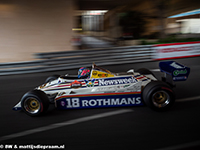
Who?Stuart Hall What?March-Cosworth 821 Where?Monaco When?2026 Monaco GP Historique (April 26, 2026) |
 |
Why?
Stuart Hall and Michael Lyons further expanded their Monaco trophy cabinets, each claiming two more top honours at this year's Grand Prix Historique. Hall took wins in races E and G, Lyons in races D and F, thereby jointly claiming a clean sweep of the Formula 1 eras from 1966 to 1985.
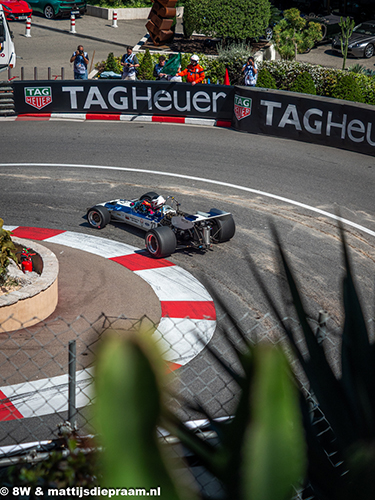
Michael Lyons blitzed the 1966-'73 and 1977-'80 grids with his Surtees TS9 and Hesketh 308E respectively. Here he is seen navigating the Fairmont hairpin in the Surtees. (photo 8W)
Two sunny days and one cloudy day with a slight drizzle marked the 2026 Grand Prix de Monaco Historique, which had a somewhat subdued atmosphere compared to previous years. The grandstands remained empty for long periods and the paddocks were also less jampacked than in the extremely popular earlier editions. Nevertheless, Monaco remains a magnificent venue for a celebration of F1 history, with the addition of a sports car race, as the principality also hosted its Grand Prix for sports cars on several occasions in the 1950s.
The excitement in this year's races was slightly underwhelming, as with the exception of two, they were all dominated from start to finish by the man that started on pole. Joe Colasacco fought his way up from fourth place to take the win in Grid B for 1.5-litre F1 cars, whilst Patrick Blakeney-Edwards was handed victory in the pre-war race on a plate when his rival Richard Bradley's Maserati ground to a halt in the very last corner – otherwise Bradley too would have joined the ranks of pole-to-win victors.
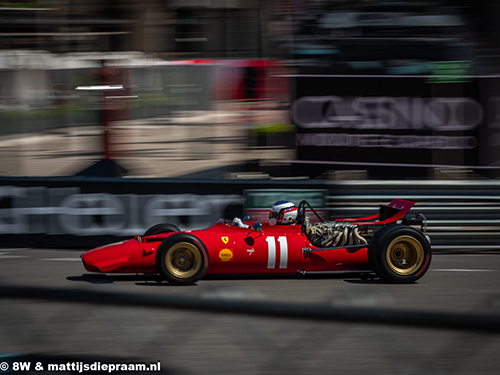
Jean Alesi made headlines for the wrong reasons by crashing the Ferrari 312, but his team made history on its own by rebuilding the heavily damaged car with a heroic all-nighter. (photo 8W)
The stars of the programme proved less fortunate. Jean Alesi's much-discussed return to the event, once again in a Ferrari, resulted in an even more talked-about crash during free practice. The 1969 312 was suddenly slung sideways whilst braking for the chicane, after which Alesi plunged head-on into the crash barrier. After pulling an all-nighter in the Riva hangar, the Methusalem mechanics managed to replace the mangled corner of the car, allowing Alesi to qualify in sixth place after all, but in the race he got no further than a single lap. In the same race, Mexican former IndyCar driver Adrián Fernández also failed to finish in Pedro Rodriguez's BRM P153. A semi-big name was that of Loïc Depailler, Patrick's son, but unfortunately, the Tyrrell 007 did not get past Saturday.
Following a Friday of free practice and a Saturday of qualifying, race day on Sunday got underway with grid A2 for front-engined GP cars up to and including 1960. Mark Shaw's Scarab was dominant in that field. Shaw initially built up an 11-second lead, before easing off towards the finish line and crossing the line six seconds clear. The real spectacle unfolded behind him. John Spiers (Maserati 250F) battled with Max Smith-Hilliard (Lotus 16) for second place, a duel that MSH decided in his favour with a fine move at Tabac. Behind them, Spaniards Joaquin Folch-Rusinol (Lotus 16) and Guillermo Fierro-Eleta (Maserati 250F) battled for fourth with a similar set of cars. This time the Maserati came out on top after Fierro managed to outfox Folch at Rascasse.
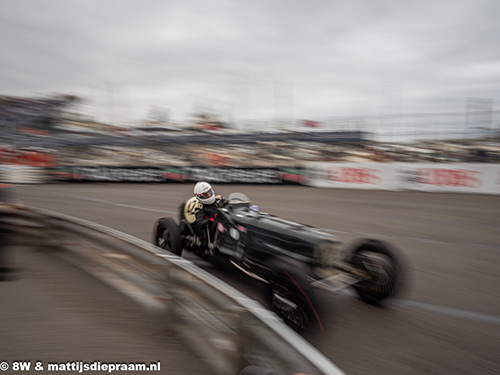
Patrick Blakeney-Edwards couldn't believe his luck when rival Richard Bradley's Maserati 4CL coasted to a halt at Rascasse on the final lap. In 2024, PBE was seen cursing his steed after it broke down at Mirabeau, but he was vindicated this time, kissing the Frazer-Nash with gusto on his way back from the podium. (photo 8W)
Next up was grid A1 for the pre-war cars. For Richard Bradley, starting from pole position, everything seemed to be smooth sailing, although hounded throughout the race by Patrick Blakeney-Edwards' Frazer-Nash, just a few seconds behind. That is… until Bradley's Maserati 4CL came to a halt in the final corner of the last lap – reminiscent of Jack Brabham's final-lap disaster in the 1970 Monaco Grand Prix... PBE was over the moon, as long after the finish, the British driver/preparer was bouncing with pure joy. Bradley's last-minute retirement handed P2 and P3 to Brad Baker (ERA R10B) and Alex Read (Bugatti T51), the young British teammate of the experienced Canadian who took second place.
The most exciting race turned out to be Grid B, the race for GP cars up to 1966 with the engine behind the driver. Shortly after the start, Mark Shaw's Lotus-Climax 21 – yes, the winner of race A2 – boldly took the lead from pole-sitter Stuart Hall, also in a Lotus 21. But there was no stopping Joe Colasacco's Ferrari 1512. The American had been consummately the fastest on Friday, but subsequently failed to capitalise in qualifying. Straight after the lights went out, he hunted down Shaw and Hall from fourth on the grid, to overtake them only a few laps later with two resolute moves before pulling away. Philipp Buhofer finished a distant fourth in his BRM P261, setting up an ever finer result in the next race.
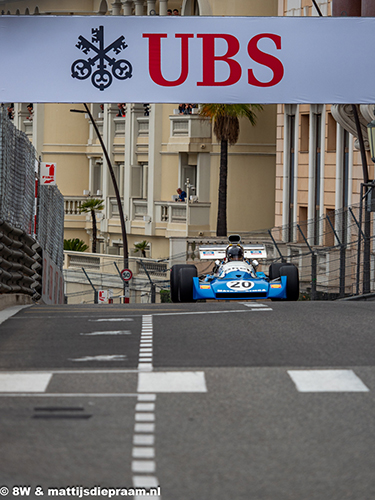
The delight of engine variety was largest on the 1966-'73 F1 grid, with Ferrari, Matra and BRM coming out to play with their majestic twelve-pots adding to the familiar raw and punchy Cosworth growl. Here, 'Mr John of B' is cresting the hill towards Massenet in his Matra MS120C. (photo 8W)
Race D marked the first of Michael Lyons' two victories that would lift his Monaco total to ten. In his mother Judy's Surtees-Cosworth TS9, no one in any other machine from the 1966-‘73 F1 era was able to match him. Ewen Sergison – in another Surtees, but the very different-looking TS9B – soon overtook Matt Wrigley (March 721G) to take second place, after which Wrigley dropped back and ultimately failed to finish. Buhofer thus secured a podium finish in the relatively old Brabham BT33, a strong performance from the Swiss driver, who seems to have rediscovered his mojo.
The morning concluded with Race E for F1 cars from 1973-‘76, with the 1973 Spanish Grand Prix serving as the dividing line – the race in which new crash protection (the so-called ‘deformable structures') became mandatory. Hall led from start to finish in Roald Goethe's McLaren-Cosworth M23, chased by Lyons' M26, but the McLaren was competing in the invitational class and therefore not classified. As a result, Nick Padmore (Lotus 77) finished second, half a minute behind, while Guillaume Roman (Boro Ensign N175) completed the podium after a race-long battle with local hero Fred Lajoux, until the latter parked his Surtees TS19 at Rascasse in a multi-car crash also involving Philippe Bonny's Trojan T103 and Doug Mockett's Penske PC4. Hall thus crossed the finish line behind the safety car.
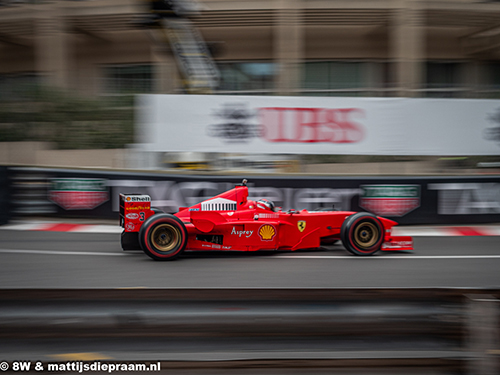
One hell of an intermission: Ferrari Corse Clienti customers provided a ear-piercing lunch break with their prancing horses from the Schumacher to Räikkönen and Alonso years. (photo 8W)
After the long lunch break featuring classic car runs and a Ferrari demo by Corse Clienti, it was time for the sports car race. Richard Wilson (Maserati 250S) proved unstoppable in this, his only notable opposition coming from Fred Wakeman (Cooper-Jaguar T38). A thrilling battle for third place between Mathias Sielecki (Aston Martin DB3S) and Nicolas Bert (Jaguar C-type) was ultimately settled in the former's favour right at the very end.
In Race F for F1 cars from 1977-‘80, it was Lyons' turn once again. In the Hesketh 308E in which he has won so many times before, he easily pulled away from the rest of the field. His closest pursuers were too busy battling each other, as AGS driver Fred Rouvier (Tyrrell 010) felt Sam Hancock's Fittipaldi F8 breathing down his neck throughout the entire race. The Frenchman, however, did not budge and held on until the finish line.
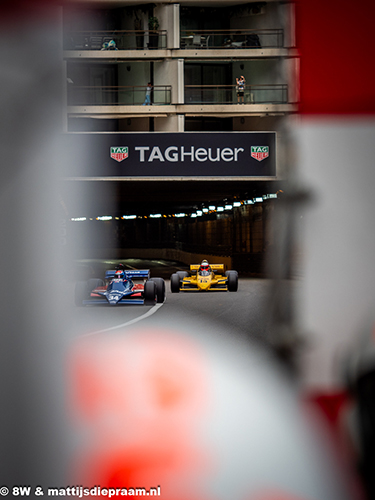
Frédéric Rouvier and Sam Hancock battled hard for the runner-up spot in Race F, the Frenchman's Tyrrell 010 holding off the Briton's Fittipaldi F8 for the entire length of the race. (photo 8W)
Hall secured his second victory in the final Race G for F1 cars up to 1985 (and turbo cars up to 1986), but as easy as it was for him, the rest of the field struggled to make it a dull race. First, there had to be a restart after Alex Kapadia's Williams FW08 had stalled on the grid. The restart, however, was marred by a major crash, as Nick Pink's Arrows A5 got sandwiched between John Inglessis's Lotus 91 and Ian Simmonds's Tyrrell 012. The safety car came out straight away and intended to lead the field through the pit lane – which in itself made sense – but after three cars, the fourth driver no longer realised that his predecessors were following the safety car! That too made sense, as you couldn't see that happening from the other side of the Rascasse hairpin. As a result, the race was redflagged.
After a long break, it was decided to restart behind the safety car and run a shortened race of 15 laps. Halls' March 821 initially felt the pressure from Marco Werner's Lotus 87B, but the German soon dropped out. This allowed Kapadia and Werner d'Ansembourg (Brabham BT49) to move up to the podium places, Kapadia having benefited enormously from the second restart, for which the original starting grid was reinstated. D'Ansembourg was chased down for the first part of the race by Jamie Constable's Tyrrell 012, until the Briton fell back.
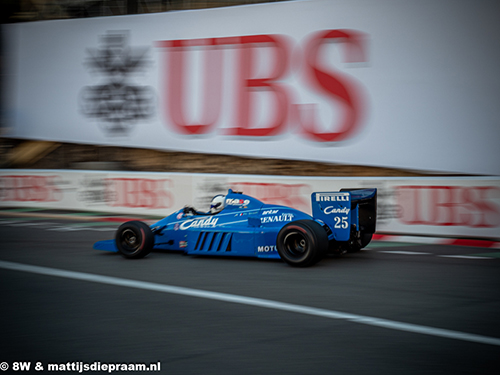
Among the turbo cars, Roman Rusinov's Ligier-Renault JS25 proved to be the most effective, the Russian-born Emirati hauling the machine up to a creditable sixth place overall and the turbo class win. (photo 8W)
The talk of the weekend centred on the debut of the turbos, which were admitted to Grid G for the first time. They may herald a new future for historic Formula 1, although it will be a costly one, with many moments of trial and error to come. Of the seven turbo cars entered, just one made it to the finish line without problems while achieving a proper result, as former WEC/ELMS driver Roman Rusinov – who now officially goes by the name of Ramzan Oruzbaev, even though his Russian name is still on his helmet – ran home his Ligier-Renault JS25 in a creditable sixth. It was a modest sign of things to come – for decades, turbo cars were considered impossible to run in a historic environment, but with modern engine management allowed it may yet prove possible.