American heir buys British disaster cars
Author
- Mattijs Diepraam
Date
- 8W November 2000 issue
Related articles
- Aiden-Cooper - The prelude to Paul Emery's last disaster, by Mattijs Diepraam
- Alan Brown - Driver-entrepeneur that scored Cooper's first points, by Felix Muelas/Mattijs Diepraam
- Emeryson Special - Colin Chapman's single Emeryson appearance, by Mattijs Diepraam/John Cross
- ENB - Lucien Bianchi and the ENB-née-Emeryson, by Mattijs Diepraam/Don Capps
- Gordini - Nimble, elegant, ultimately French, by Mattijs Diepraam/Felix Muelas
- Teddy Pilette - Third generation of a racing family, by Mattijs Diepraam/Leif Snellman/Felix Muelas/Eric Verkaaik
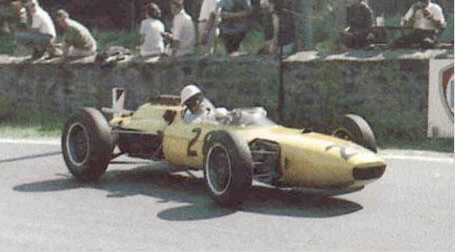
Who?André Pilette What?Equipe Scirocco Belge Scirocco-Climax SP Where?Spa When?1964 Belgian GP (14 June 1964) |
 |
Why?
Do you ever get the feeling everything in this world is connected? That you just need to know someone who knows someone else who knows someone who happens to know a guy in the Ferrari team working close to Michael Schumacher? You could well be right since logic tells us that you are never more than six people apart from anyone else on this planet. In motorsport, the Six Degrees law is present in condensed form. You only need to study Grand Prix history for a month or two and you will be surprised how everyone got involved with everyone else during any time until today.
Here's another prime example.
When we got caught up in the ENB/Emeryson story, we did not tell you the whole story. Nor did we when we told you about the Pilette motorsport generation game. Here is the missing chapter. It's entitled: How André Pilette managed to fall into the same trap for the second time.
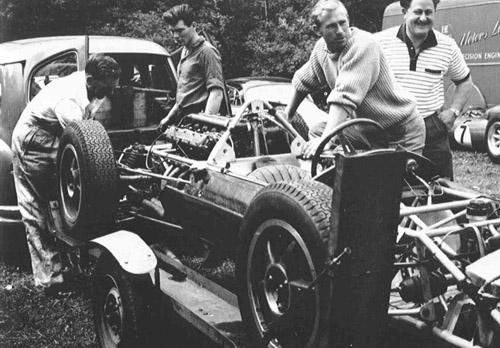
This particular subplot starts at the end of 1961. The Emeryson 1000 series, built in the old Connaught works at Send, had failed to deliver any substantial results. The three cars delivered to the Ecurie Nationale Belge had brought little gain to the Belgians and would continue to do so into 1962. After the Monaco disaster the Ecurie sold the prototype to erstwhile ENB co-founder André Pilette, who replaced the ancient Maserati 150S powerplant with a Coventry Climax FPF unit, but the second-generation racing Pilette (here seen at the Brussels GP with the car) fared little better with it. He qualified the car for just one race, the non-championship Austrian GP at the boring Zeltweg airfield track, where he finished dead last.
However unsucccessful, the Emeryson 1000 was the first Emery-designed car in a long time to come near a Grand Prix grid since 1956, when he successfully qualified his Alta-engined special for the British GP. Before being picked up by new Connaught owner Alan Brown, Paul Emery had been involved in projects such as sticking a self-developed 2.4-litre Jag engine in the back of an Aston Martin DB3 (just as Geoff Richardson had done, see this Shelby story), rebuilding a flat-four F2 engine which was tested in a Morris Minor, installing the Connaught-developed Alta engine into the back of a Cooper F1 chassis to create the Cooper-Connaught, and, finally, he completed the previously unraced Connaught C to field it for Bob Said in the 1959 US GP.
In 1960, with the support of Alan Brown, odd-job man Emery founded Emeryson Cars Ltd, which would be located at Send. Paul's first creation would be the ENB-run Emeryson, which would need additional development, as was shown by its poor early-season form. During 1961, Emery's factory indeed sprouted a Mk2 version. Initially, it was decided it would be run by the works in non-championship events only, with a young Mike Spence taken on as the driver. Just before, Mike had starred in the Commander Yorke Trophy, a Silverstone-based Formula Junior event. With the FJ version of the Emeryson, Spence won - it was the only win for the car. Then on his F1 debut at the Solitude, he ran seventh in the Mk2 while stuck in gear before retiring. In the Lewis-Evans Trophy at Brands, a small British privateer event late in 1961, Mike took second place. Meanwhile, a sportscar version of the F1 design took a class championship in the British Hill Climb Championship.
Then, at the end of the season, Emeryson Cars Ltd got a very strange co-owner. Hugh Powell was an American, still in his teens and superbly wealthy. His guardian was racing driver Tony Settember, who came up with one of the most original ways of getting yourself a Grand Prix drive - have your protégé buy you a team! Unsurprisingly, Alan Brown was out soon, unwilling to get involved in the foolish frills of an American teenager. Emery, however, stayed on and masterminded a 1962 Grand Prix assault for Settember and John Campbell-Jones. Originally, the plan was to create a four-wheel drive car with two 750cc motorcycle engines directly on top of both axles. In all its bizarre unusualness, the idea was typical Emery - just like the radical front-wheel driven and disc-braked 500cc he had penned as early as 1950 - and had Paul still been his own man, there is no doubt he would have gone on and built it. As it was, Powell and Settember moved him into creating a slightly more sensible Mk3, which would have been highly innovative in itself, had Emery not turned back on his original plan to build it around a glass-fibre monocoque! Because of the cost, the team decided on a yet more conservative route, instead creating a semi-monocoque, with fuel tanks on the side carried by a stressed mid-section. In the front the radiator was mounted almost horizontally.
The car wasn't bad as such - it only needed a decent engine to show its real potential. A new BRM or Climax V8 unit never arrived, however. Also, big-sized Settember had trouble fitting into the cockpit, which seriously hampered his performance. This allowed second driver John Campbell-Jones to develop into easily the faster of the two. In the Aintree 200, for instance, Campbell-Jones finished sixth, while qualifying 10th out of the 24 cars present at the International Trophy. Understandably, this did not go well with team leader Settember, and the atmosphere within the team soon turned acidic. The cars getting outpaced in their few Championship appearances did not help, and so before the end of the season, the British part of the team, including Emery and Campbell-Jones, quit the team.
So for 1963, Powell and Settember decided to go it alone. They changed the team's name to Scirocco-Powell and moved into a shed at the back of the Seven Stars pub in Goldhawk Road, London. They must have spent several inspiring hours in the pub, for the team carried seven stars in their logo…
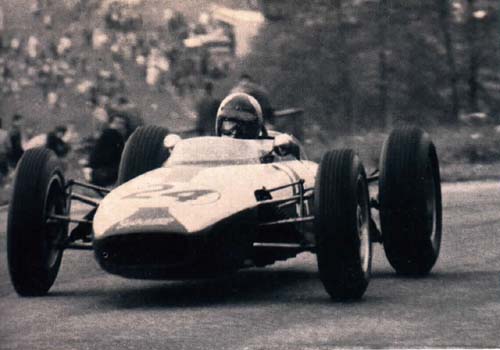
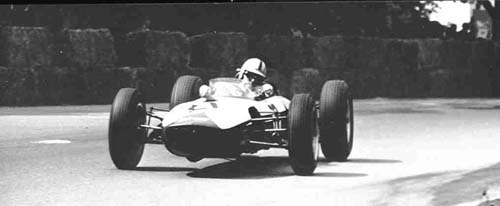
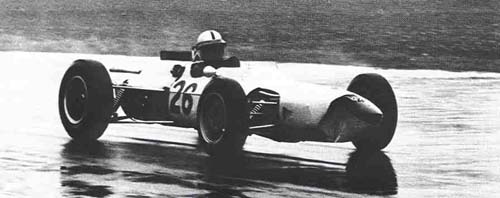
Putting their inspiration to use they modified the Mk3 design to fit BRM V8 engines and came up with two new chassis (SP-1-63 and SP-2-63) which, when fitted with wheels and suspension, performed every way like a car conceived directly behind a pub, or so it seems. Driven by Settember and Tony Burgess in blue-and-white American national colours, the cars were always well off the pace. On the occasions either of them managed to qualify their mounts for World Championship events (such as here at Spa) it was invariably at the back, while they seldomly lasted the distance. There was one huge exception, Settember finishing second in the Austrian GP, but to put things in perspective, this was a poorly supported non-championship event which had just three finishers. Oh, and Settember finished five laps down on the winner…
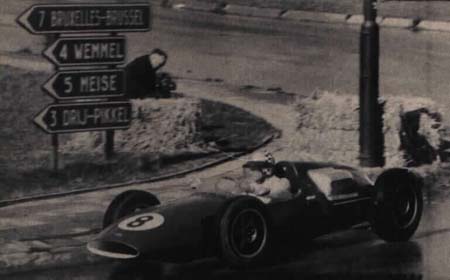
By the end of the year Hugh Powell was fed up with the money pit named Scirocco and sold the cars. And this is where André Pilette comes in (again). The Belgian became the proud new owner of SP-2-63, the ex-Burgess machine. He then proceeded to swap the BRM unit for a Climax FWMV, and entered the yellow-painted car (here seen at the Daily Mail Trophy at Snetterton) for the 1964 championship under the banner of Equipe Scirocco Belge. His form? André could have guessed himself. Three years after buying the Emeryson 1001 he acquired a car that was based on the very same design…
And still the Scirocco hadn't been the end of the road for Paul Emery. Two years later, Paul got hold of the stillborn Coventry Climax FPE 'Godiva' engine and enlarged the original 2.5-litre unit to 3 litres. 2.5 litres, you say? Well, yes, this engine was designed a full dozen years earlier by Coventry, at the start of the 2.5-litre era which was to last until 1960. Now it was 1966 and in the meantime two whole engine formulae had had their day. Pleading in favour of Emery was Cooper's practice of using the ageing Maserati powerplant for their 3-litre car, in a similar ploy to Emery's. But then the Maserati was a tested engine with racing mileage to spare. The FPE had never once ran in anger.
As was the case with all Emery projects, this one also had an imaginary counterpart which was so wild and outrageous that it was bound not to be built, although once again Emery proved himself a visionary. This time, Paul envisaged a four-wheel drive F1 car powered by a flat-eight turbocharged two-stroke engine based on two Hillman Imp blocks! The idea must have come up during his 1965 work on an Imp GT racer. As usual, lack of money prevented the concept from nearing its realization. But it must be said that Emery saw the advantages of turbocharging - and mating the turbo concept to a two-stroke engine - a decade before Renault jumped on the idea.
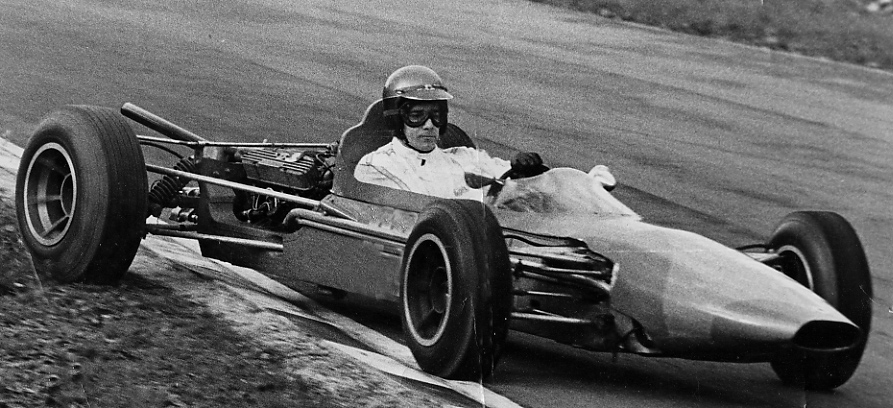
Meanwhile, the project that could be finished went ahead as planned. After adapting the FPE unit to run on pump fuel instead of aviation gas, using Tecalamit fuel injection, Emery stuck the Godiva in the back of a creation by none other than… ex-Scirocco designer Hugh Aiden-Jones, the same man that came up with the Aiden-Cooper and the Pearce. The Shannon was another anomaly among the ordinary and its history would turn out even stranger, as the erstwhile F1 car was converted into an F3 car (picture courtesy of Allen Brown) as late as 1969, Australian John Wilson racing the MkI (as it came to be known) with an EMC engine in the back.
In its intended F1 guise, the Shannon-Godiva raced just once - and in doing so it claimed an unenviable record. For the 1966 British GP Aiden-Jones and Emery found a solid driver, the once great Trevor Taylor, who with the help of that season's shortage of pukka 3-litre cars got the machine on the grid. Trevor managed to get the car going but then the fuel tank split before he could complete his first lap... Apart from perennial non-qualifiers such as Life, Shannon's less-than-a-lap appearance still stands as the shortest Grand Prix race career by a single marque.

Reader's Why by Alessandro Silva
"The need for racing can lead you to error". The middle protagonist of an often told racing saga of father, son and grandson richer in enthusiasm than in victories, is portrayed here on one of his many varied and sometimes (as in this case) extravagant mounts.
The son of Theodore Pilette, the Daimler Benz concessionaire after Mercedes' father Jellinek and the driver of GP Mercedes before WWI, and the father of Teddy, the European F5000 champion in 1973 and 1975 and later the builder of a F3 car bearing the family name, André Pilette (1918-1993) took up racing in the forties on the very good but forgotten HRG sportscar. One of the many Belgian semi-professional drivers that populated top level F1 and sportscar racing in the fifties forming variously named Ecuries and Equipes always with the same drivers and varied machinery, André soon took Johnny Claes' Ecurie Belge yellow Talbot Lago 26 to sixth in the 1951 home GP only to write off the car one year later at Albi. An almost winningless sportscar career, started in 1953, developed mainly at Le Mans and the Nürburgring with a second at the Le Mans 24hrs race in 1960 co-driving with Mexican wonderkid Ricardo Rodriguez (see the previous Why) in a NART Ferrari as top result. The list of sportscars driven by André in these events can be taken as a list of almost all sportscars of the period: Borgward, Jaguar D-type, Maserati 150S, Ferrari 750, Lister Jaguar, Alfa Romeo Giulietta SV Zagato, Porsche 356, AC Bristol, various Ferrari 250 and it is ended by a Porsche 904 with a retirement at the Nürburgring 1000kms race in 1964. Pilette also drove Gordinis at the Le Mans 1954 and 1956 races. The reason is that in these years Pilette was a driver of the works Gordini team, enjoying his only periods of regular professional F1 driving. In 1954 he took his first and last championship points with a fith at the home GP and seconds at Chimay and Cadours, fourth at the AVUS and fifth at Aintree in non-championship races. Back in the deteriorating Gordini team for 1956, he took the heavy, slow and unreliable 8-cylinder car to sixth at Monaco sharing the drive with Elie Bayol.
In the fifties Ferrari used to loan one of his cars to ENB to race the Belgian GP under a yellow livery, due to his good relationship with his Belgian importer Jacques Swaters. In 1956 the choice for the wheel of a Lancia-Ferrari came upon Pilette who took the car home for another sixth place. A big crash in the Gordini in practice for the German GP put André's career to a two years stop. In 1962 and '63 André and son Teddy campained two FJ Merlyn-Fords with André graduating Belgian FJ champion for 1962.
André's last F1 attempts were rather insane and they can only be explained by passion for racing and the need of non-expensive cars to fullfill it. He took the infamous former ENB Emeryson now with a Climax engine to the Italian GP where he managed not to qualify while 32 (!) cars did and among them a DeTomaso-OSCA. A chronicle from 1962 says: "...former GP driver (sic) André Pilette planned an abortive F1 car based on the FJ Merlyn with a 1.5L Ford engine...", while in 1963 he bought the former Tim Parnell Lotus 18 and never qualified it in championship races. Finally he bought a Scirocco chassis, mounted a Coventry-Climax 8V engine in it and entered it at Spa (retirement) and the Nürburgring (DNQ) in 1964. His racing career ended at the wheel of that extravagant car.
Californian of Italian descent Tony Settember was a late fifties SCCA driver who went to Europe for a brief racing stint and was behind two strange racing car building efforts. In 1960 he had a sportscar Maserati special built in England, called WRE. It was a front-engined car powered by the 4-cylinder Maserati 2L engine and it had a chassis of English conception better than the one in the now ageing Maserati 200S. The 2L sportscar class was immensely popular in Italy since right after WWII and it was to be the proving ground for drivers such Ascari, Musso, Castellotti up to Nino Vaccarella. Settember took the car to the 2L class supporting race at the Naples GP and won it easily, creating some sensation in the Italian motoring press who thought that a new promising star had risen. Local drivers and old 2L class mainstays Luigi Bellucci and Mennato Boffa immediately ordered replicas. Unfortunately Maserati was putting out theirs 2L "Birdcage" sportscar that was a much better car and that was the end for WRE.
Settember was the guardian of young and rich American Hugh Powell and with his money Emeryson was bought into and Emeryson chassis were made to be driven by Settember and Campbell-Jones for the 1962 F1 season. The combination of Emeryson chassis with a Climax 4-cylinder engine was outclassed and Settember talked Powell in getting rid of Paul Emery and in financing the construction of a totally new F1 car for 1963. The shop was set up in the backyard garage of a pub in London. The pub's logo was incorporated in the team badge! Two chassis were built but unfortunately the layout of the Emeryson was maintained with the only adding of lateral upper links at the rear suspension. The cars were powered by the 8V BRM engine and they were fitted with a slim and rather pretty body. Painted in American racing colours, the cars did not appear until the Belgian GP where one only showed up and Settember qualified, finishing eighth. Suspension sprung the car very high on the ground and it was very difficult to handle and atrociously slow. The second car was entered for the RAC GP for Ian Burgess, who added in this way another exotic drive to his impressive list, to no avail.
In August the superficial newspaper reader came across the surprising news of a Scirocco classified second at the non-championship Austrian GP behind Jack Brabham. But a more careful reading showed that Settember was five laps behind and the finishers were only three. After this "triumph" things got even worse and despite a decent showing by Ian Burgess at the Gold Cup in Oulton Park, Powell decided that this was not the way to pour his money down the team and both cars were sold. Burgess' race car was sold to André Pilette and this winds up the Pilette-Settember story.
But it was not the end of a thread of F1 disasters beginning with Emeryson through Aiden-Cooper, Scirocco, Shannon and ending with Pearce. One main link, the other being Paul Emery, of this thread was Scirocco design consultant Hugh Aidan-Jones, formerly a mechanic for Mrs Bryden-Browne's Anglo-American Racing. In 1962, with his patroness' money, he fitted a 4-cylinder Coventry Climax engine in a modified FJ Cooper chassis. Driven by, who else, Ian Burgess, the car was very, very slow. After his stint at Scirocco, Aiden-Jones' name was linked with the design of the unsuccessful F3 Shannon and he partnered with no one else than Paul Emery in the F1 Shannon effort. The car, powered by a 8V Coventry Climax Godiva engine unearthed by Emery, lasted less than one lap in the RAC GP in the hands of an astonished Trevor Taylor. Aiden-Jones' name was to be found the next year entered as a driver for the Pearce powered by the Martin V8 engine for the Silverstone Daily Express Trophy when the three-car team was burnt to ashes in a fire in the paddock. With some relief, Aiden-Jones disappeared from F1 records after that.