The first Grand Prix
Author
- Leif Snellman
Date
- 8W Millennium issue, Reader's Why: May 27, 2002
Related articles
- The Gordon Bennett races - The birth of international competition, by Leif Snellman
- 1914 French Grand Prix - Remember it for the one who lost, by Leif Snellman
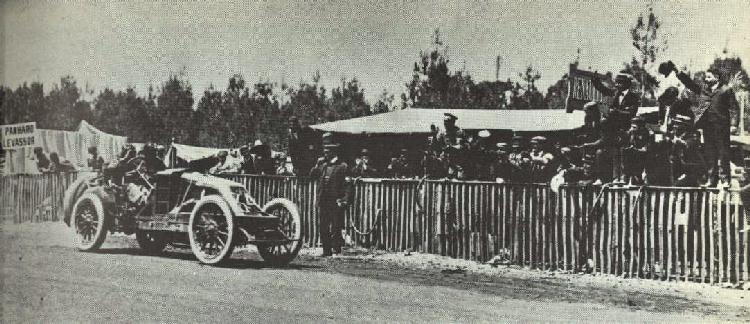
Who?Ferenc Szisz (with riding mechanic M. Marteau) What?Renault AK 90CV Where?Le Mans When?1906 ACF GP (IX Grand Prix de l'Automobile Club de France, 26-27 June 1906. This is of course the first French GP, not the ninth, but the French have retrospectively included the old city-to-city races in their GP count) |
 |
Why?
While the Gordon Bennett Cup races (1900-1905) had been an undisputed success for promotion of motorsport, the races had left France, the country that totally dominated car manufacturing in the early 20th century, more and more frustrated. The problem was not so much with the results, as they had been victorious four times out of six, but because while other nations had to struggle to collect a team, the French had to eliminate most of their potential entries. Thus with only three French cars out of 29 qualifying for the 1904 race, manufacturers like Clément-Bayard, Darracq, De Dietrich, Gobron-Brillié, Hotchkiss, Panhard, Serpollet and Turcat-Méry found themselves without a chance for fame and honour even before the Gordon Bennett race started. The same thing happened in 1905. With 24 French cars looking for the three spots in the final, Automoto, CGV, Clément-Bayard, Darracq, Gobron-Brillié, Hotchkiss, Panhard and Renault found themselves out of luck.
When the Gordon Bennett Cup was born in 1899 the motor industry was still struggling to make their products work at all. By 1906 racing had turned into a fight between the constructors for marketing their products. So the French decided to kill the Gordon Bennett races and replace it with something else, a race in which all manufacturers could have a chance to compete. Thus the Grand Prix was born. To be accurate the name Grand Prix was not in itself new to motor racing. In 1901 a race called the Grand Prix had been held at Pau. But the 1906 race was the first real Grand Prix, the start of what is now known as Formula 1 racing.
The Renault company had been founded in 1899 by Louis Renault and his brothers Marcel and Fernand. Louis and Marcel had immediately seen the marketing value in motor racing and their successes in the town-to-town races made the name Renault famous in an instant. Then came the catastrophe as Marcel had a fatal crash during the disastrous 1903 Paris-Madrid race. Louis Renault decided he would never again start in a race himself. However he still recognized the promotional value of racing so his cars would go on racing.
Louis' mechanic in the Paris-Madrid race had been Ferenc Szisz, a Hungarian born in 1873 in the Austro-Hungarian empire. After advancing to become the head of the Renault test department Szisz also became the head racing driver for the company. He failed to qualify for the 1905 Gordon Bennett race, finishing 5th in the French eliminating trials. He then went to another 5th place at the Vanderbilt cup in USA.
For the 1906 Grand Prix Renault decided to enter a full 3-car team. For that historical event the organizers selected a place near Le Mans in central France and it became known as Circuit de la Sarthe. (Note that the only thing that track has in common with the modern Circuit de la Sarthe where the 24h race is held is that the organizer is the same for both events: the Automobile Club de l'Ouest.) The 1906 track had a length of 103 km and the cars had to run 12 laps, 6 laps on Tuesday 26th and 6 laps on Wednesday 27th for a total of 1236 km. Compare that to the 305 km in current GP events!
There were 32 starters from 12 manufacturers, three cars each from Brasier, Clement-Bayard, Darracq, FIAT, Hotchkiss, Lorraine-Dietrich, Itala, Mercedes, Panhard and Renault, with single-car entries from Gobron-Brillié and Gregorie. Each team had a number with a letter identifying the individual cars. The red painted Renault cars had the codes 3A, 3B and 3C to be driven by Szisz, Edmond and Richez. The Renault factory decided to retain the 1905 engine and build a new chassis. The engine was an enlarged variant of an engine first built in 1903. It had 4 cylinders with side valves (166*150mm = 12985cc) giving 95bhp at 1200rpm, a modest number compared to 110bhp for Clement-Bayard and FIAT. The transmission consisted of a 3-speed gearbox with spiral spring clutch and a shaft drive. Renault decided to race the cars without differential to keep the weight down as there were only three major corners during a lap. The chassis was of a conventional channel frame type with semi-elliptic springs all round.
But there were some notable novelties on the car. One was the hydraulic dampers invented by Louis Renault himself, the first ever on a racing car. The other were Michelin's new detachable rim wheels, Jante amovible. In those times tyre changing was a complicated business involving cutting the old tube away with a knife and then forcing on the new tyre. On the new system the rim was attached to the artillery wheel with eight bolts and easy removable. As the new Grand Prix rules demanded that the driver and the mechanic should do all the pitwork themselves, the advantage of the new wheels was so enormous that Renault and two other manufacturers whose cars were well under the 1000 kg weight limit decided to use them in the race even if the wooden artillery wheels each weighted 9 kg more that a wire-spoked wheel. Renault used the new system on the rear wheels and ordinary artillery wheels at the front.
The first car started at 6 AM and was followed by others with 90 seconds intervals. It turned out to be an extremely hot day with temperatures up to 49 degrees Celsius! The track that was littered with sharp stones proved to be a tremendous test for both men and cars. A tar mixture that had been used on the track surface, a precursor to later asphalt roads, melted in the heat and tar hit the exposed skin of the competitors creating bad burns. Renault driver Edmond had to retire with burns and glass in an eye. All three Itala cars were out before half distance and several others were also forced to call it a day. Szisz, who was known for his mechanical sensitivity, started off at a good, fast pace and after a fine 3:47 pitstop he took over the lead on lap 3 and held it until his car was flagged off after 5:45:30.4 and moved into the parc fermé for the night. Second after the first day was Clement (Clement-Bayard), 26 minutes behind Szisz, with Nazzaro (FIAT) third and Shepard (Hotchkiss) fourth.
There were 17 cars left to start the second day. The cars were started according to the time in the first day. Szisz started off at 5:45.30 AM and immediately stopped the car again for a tyre change and complete service. Still, he was off again 14.5 minutes before Clement was allowed to take up the chase. Szisz continued to drive a safe race, nursing the car, and not even a broken rear spring on lap 4 could hinder him from opening up the gap further from his rivals. The heat was as bad as the day before making the race into a "race of tyres" with the teams using the Michelin system in a clear advantage. At the end Szisz took the flag after having run for a total time of 12:14:07.0 to finish over 32 minutes in front of Nazzaro, whose Jante amovible wheels had made him able to pass Clement. Richez in the second Renault had crashed after having made a record 1:15 pit stop. Fastest lap of the race had been made by Baras (Brasier) with a time of 52:25.4 while the top speed on the straight had been recorded by Szisz's Renault with 154 km/h.
11 cars were able to reach the finish. The results:
1. Ferenc Szisz, Renault, 12:14:07.0
2. Felice Nazzaro, FIAT, 12:46:26.4
3. Albert Clement, Clement-Bayard, 12:49:46.2
4. Jules Barillier, Brasier, 13:53.00.0
5. Vincenzo Lancia, FIAT, 14:22:11.0
6. George Heath, Panhard, 14.47:45.4
Szisz then finished second to Nazzaro in the 1907 GP and retired in the 1908 race and the 1908 American GP. After that the name Renault slowly disappeared from the GP tracks until the return in 1977. Ferenc Szisz himself lived on until 1970. But then Szisz was the first GP winner and his name will always be included in the record books (but occasionally misspelled). Szisz seems to be a tough name for GP historians, as sometimes we see him called Frank Szisz or Francois Szisz, probably according to the nationality of the writer...
Reader's Why by Geza Sury, with additional input from Hans Etzrodt and Jimmy Piget
Now, that Zsolt Baumgartner is racing for Nordic in F3000, a small country in Central Europe is hoping that someday he will graduate to Grand Prix racing and Hungary would have a Grand Prix driver after a long-long pause. No Hungarians ever made it the Formula One, but the first ever Grand Prix to have been held had been won by a driver from this small country. His name was Ferenc Szisz. As a countryman of him, I tried to collect everything about this man, facts that were never published abroad, pictures never seen before.
Before we start, one thing must be cleared up. His correct name was not Ferenc Szisz, rather Szisz Ferenc. Why? The correct answer is that in Hungary the order of the names are the opposite from what's common in most countries, that is: first comes the family name, than the given name(s). So, the name of the driver who made history is actually Szisz Ferenc. Or, to complicate the situation a little further: Szisz Ferencz. "Ferenc" is quite a common name in Hungary, its ancient spelling was "Ferencz", but after some modifications in Hungarian grammar, it was simplified.
Szisz Ferenc was born in Szeghalom, in Hungary on 20th September 1873. Ferenc was baptized five days later in Korosladany. You can see his original certificate of baptism here. His family name is orientated from the German word 'süß', which means 'sweet'. His ancestors were Saxons. It was his grandfather, who came to Hungary (from Transylvania, where many Saxons had lived) and took part in the 1848 Hungarian War of Independence on the Hungarian side. His son - the father of Ferenc - worked as a chief stableman at the time Ferenc was born. His mother was Julianna Somogyi, the couple had seven (!) children, Ferenc being the sixth youngest. Ferenc pursued his studies in Doboz, where his father worked as a person in charge of Count Frigyes Weinkcheimen's croft. At the tender age of 23 he was already interested in cars. He earned his profession as a locksmith and a copper-worker. In his spare-time, he studied contemporary car designs and learned engineering.
He was destined for more, so he travelled to Vienna, then to Salzburg, then to Munich, then to Berlin and finally ended up in Paris. He joined the Renault factory on 1st May 1900. The Renault brothers recognised his talent, so Szisz shortly became the leader of the Renault test department. In the meantime, he started racing as the riding mechanic of Louis Renault. Their first event was the 1902 Paris-Vienna trail, with the Renault in the light-car class. After mixing with the leaders in the early part of the race, they lost several hours in Austria due to accident repairs and ended up in place 28.
Early in 1903, however, Marcel was killed in an accident on the disastrous Paris-Madrid race. Louis decided to give up racing and it was not until 1905 that he was convinced to build a new racing machine. This low-slung car first appeared in the Elimination Races for the Gordon Bennett Cup event in 1905 and Szisz made his debut as a driver racing under the name François Szisz, the French equivalent for Ferenc. He was one of the three Renault drivers, alongside Maurice Bernin and the little-known J Edmond. Although Szisz was fastest of the three Renault drivers, he could only hold fourth place after one lap and fell back to eleventh by half time. Despite overheating problems of the pump cooling system and tyre troubles, Szisz nursed the Renault home into fifth place on the demanding Auvergne circuit in the hills above Clermont-Ferrand. Only the first three finishers made it through to the Cup itself. The event was won by Leon Théry.
At the end of the year he was sent to America to race in the Vanderbilt Cup at Long Island. On the second lap, he had worked himself into second place. A leaking radiator, ignition and tyre trouble eventually put him one lap down. At the end of the race after the fourth car had passed the finish, the disorderly crowd poured on the course with the battle still in progress and the race had to be called off. Szisz in fifth position with the others behind him had to stop in the middle of the course and did not take the flag.
In 1906, the French Automobile Club organized the very first GP race, the 'Grand Prix de l'Automobile Club de France' at Le Mans. The event took place on the 26th and 27th of June. The factory entered the race with three cars driven by Edmond, Claude Richez and of course Szisz. The three Renault AK's were equipped with the latest Michelin tyres, which played a main role at the race. The race started in Le Mans, then the drivers headed to St. Calais, than to La Ferté Bernard, and finally back to Le Mans. One 'lap' was 103,18 km long, and they had to cover 12 laps throughout the two days. The cars were started one after the other with one-and-a-half minute gaps. Szisz took the lead on lap four (some sources suggest lap three) and at the end of the first day he and his riding mechanic M Marteau had a 26-minute lead over the second placed driver. His arch rival, Felice Nazzaro was third in his Fiat 130hp. The Italian had more power under his car's bonnet (the power output of the Hungarian's car was around 105bhp) but Szisz and his mechanic were better when it came to changing the wheels. Both drivers' cars were equipped (as well as Vincenzo Lancia's) with Michelin's latest tyres, which could be changed relatively quickly. The rough roads took their toll on the cars, the drivers and mechanics were constantly busy making tyre changes.
On the following day Szisz continued his good form and finally covered the distance in 12 hours, 14 minutes and 7 seconds, averaging more than one hundred kilometres per hour! (To be exact: 101,8 km/h.) When he arrived at the finish he had a more than half an hour lead over Nazzaro. Vincenzo Lancia finished the two-day torture in 5th position. Szisz received his prize money (45,000 francs) from French Labour Minister, Barthou. He became a big star in France. Posters and postcards were printed picturing Szisz as the winner of the big event. Here's a postcard that he sent back to his relatives to Hungary. The translation of his handwriting is the following: "Ask the Rumanian lady to translate what is written above. Your brother: Feri." (Feri is a common nickname for Ferenc in Hungary.)
One year later both Szisz and Nazzaro entered the same event, but this time Nazzaro was victorious, and Szisz had to settle for second place. Szisz restrained himself because of the fuel consumption rules in place that year. By doing so, he finished second, only seven minutes behind Nazzaro's Fiat. After the race the cars were checked and while Szisz had 301 litres fuel left in his Renault, Nazzaro was down to 111 litres. There was of course speculation to the effect that Szisz might have won had he not worried so much about his fuel.
In 1908, Szisz started this event for a third time, but this time he wasn't so lucky as the tyre of his Renault had shattered and he had to retire after lying in third place. Later in the year, Szisz also took part in the Grand Prize Race of the Automobile Club of America at Savannah. He worked himself up to second place by lap three but retired on lap six with broken wheel bearings while in sixth position.
On 1st January 1909 Szisz left the Renault factory probably because the company had withdrawn from competition at the end of 1908. He opened a garage in the Parisian suburbs at Neully. According to his business card the garage was engaged in repairing Renaults and Delaunay-Bellevilles. After a six-year absence from the race tracks, Szisz made his return at the 1914 Grand Prix de l'ACF at Dieppe driving for Alda. The owner of the Alda factory, Fernand Charron asked him to drive one of their cars. This car was a far cry from the Renaults Szisz previously driven and Szisz had to change his radiator (!) on lap 4. On the 11th lap he was forced to stop to change a wheel. As he was doing this he was hit by the errant Opel of Carl Jorn and suffered a badly broken arm. The Alda of Szisz, afterwards driven by his lightly injured mechanic, rolled into the pits on lap 11. Despite his condition, 18 days later, Szisz won at a minor 357.3km French road race near Rochefort on the Anjou circuit. He drove a 12-litre Lorraine-Dietrich and came first after 3h31m06s averaging 104.6 km/h. He said that the course was just as difficult as that used for the Grand Prix.
He was a volunteer in the French army during World War I and became the leader of the French transport troops fighting in Algeria, thus he was given French nationality. After eight months, he was infected by the typhoid virus and subsequently returned to Paris for healing. After the war, he started working at the Breugeot aircraft factory. Believe it or not, Szisz made a short return to racing as he participated in a sportscar event driving a La Buire at Lyons. Four La Buires were entered for this race - none finished.
In the beginning of the 30s, Szisz had retired from business and devoted his time to gardening. In the meantime, he got married to Barbe Dorn, and the couple led a peaceful life in Auffargis (Seine-et-Oise) some 40 kilometres from Paris. Some sources suggest that his relatives from Hungary visited him regularly, but I'm not sure about that. According to other sources he was a friend of Russian racing driver Sergey Dimitriewich, with whom they had been team-mates at Renault in 1908. He visited Szisz often in his Villa. Szisz Ferenc died peacefully at his home on 21st February 1944. His wife followed him in 1958. Today, their grave is maintained by the ACF and the Renault factory itself.
Meanwhile some Hungarian historians claimed that they had found Szisz, who returned to Hungary. They even took him to the International Budapest Fair in 1956, where this picture was taken! He gave an interview with fake data about "his" date of birth, "his" racing activities, etc. But who was this person? Perhaps one of the brothers of Szisz? Only heaven knows. This crook has fooled a lot of historians with his story and a lot of Hungarian sources still suggest that indeed Szisz lived in Hungary after the war. All we know is the "crook Szisz" died in 1970 in Tiszaszentimre. Today, there are no persons under the name of Szisz in the Hungarian phone registry. So the identity of this person perhaps will remain a mystery forever.
The author would like to thank the members of the Atlas F1 Nostalgia Forum for their help and valuable information.