The Gordon Bennett races - the birth of international competition
Author
- Leif Snellman
Date
- 8W Summer 2001 issue
Related articles
- The 1906 French GP - The first Grand Prix, by Leif Snellman
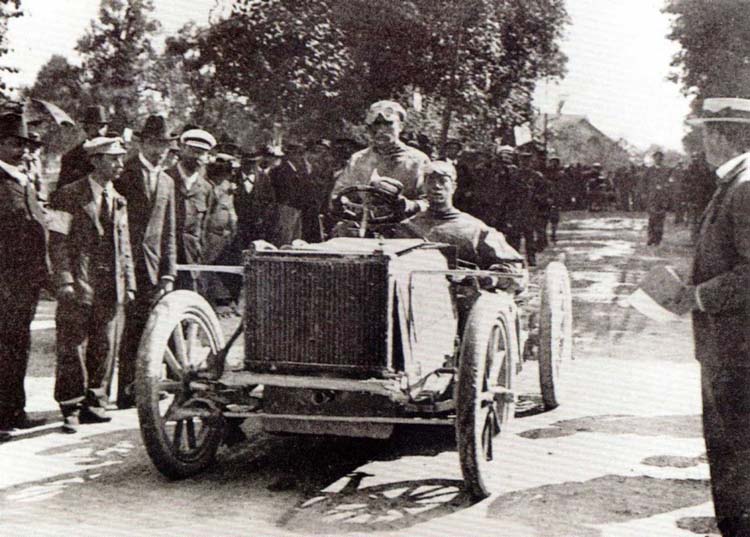
Who?Selwyn Edge What?Napier 40hp Where?Paris-Innsbruck When?III Coupe Internationale, 'Gordon Bennett Trophy' (26-28 June 1902) |
 |
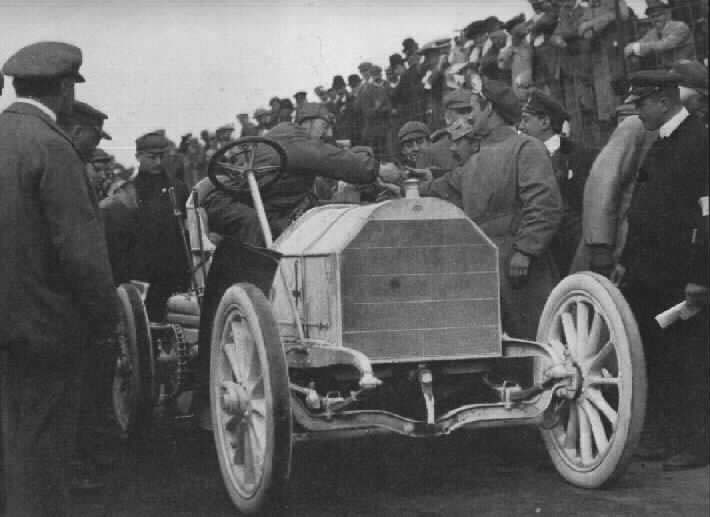
Who?Camille JenatzyWhat?Mercedes 85hp Where?Athy When?IV Coupe Internationale, 'Gordon Bennett Trophy' (2 July 1903) |
 |
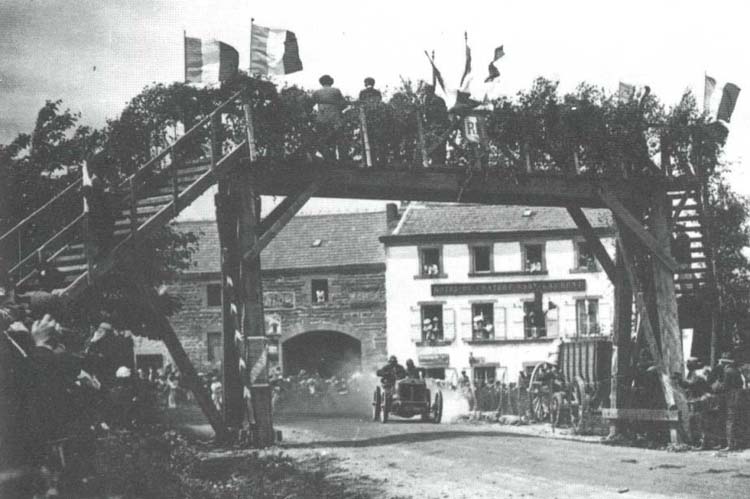
Who?Léon ThéryWhat?Brasier 96hp Where?Auvergne When?VI Coupe Internationale, 'Gordon Bennett Trophy' (5 July 1905) |
 |
Why?
James Gordon Bennett himself never witnessed any of the six Gordon Bennett races now considered to be the ancestors to modern Grand Prix racing. In fact he objected to have his name associated with the races at all and preferred to call them "Coupe Internationale".
Gordon Bennett, owner of the New York Herald, had been known to be a supporter of controversial events. It was in fact Gordon Bennett who had sent out Stanley to look for Livingstone in darkest Africa back in 1869 and he had also been involved in sponsoring an Arctic expedition. In 1899 he turned to motor racing, donating a silver trophy to encourage manufacturers particularly in United States to develop the cars through competition. Setting up the rules for the future events there were two controversial things that eventually would prove fatal for the survival of the Gordon Bennett races. First, entries were limited to three cars per nation, the entries representing the national automobile club rather than a manufacturer, and second, all parts of the cars including tyres had to be manufactured in the country the cars represented.
The two first races in the series proved to be quite farcical affairs, with only France showing up with full three cars entries to dominate the races, Charron winning for Panhard in 1900 and Girardot doing the same in 1901.
1902
The 1902 Gordon Bennett race was run over a distance of 565 km from Paris to Innsbruck in conjunction with the Paris-Vienna race. There were 219 entries for Paris-Vienna but only six of them were competing for the Gordon Bennett Trophy, three French and three British entries.
There was much doubt that the race could be arranged at all. After a series of accidents in 1901 the French government had announced a total ban on motor racing. Racing was also forbidden in Switzerland and special permission had to be granted for the cars to pass the country. In the end ACF came to an agreement with both the Swiss authorities and the French government. There was a huge surplus of alcohol production in France and by giving promises to encourage the competitors to run on alcohol as propaganda for its use as fuel, permission was granted for running the event. Two special prizes were set up for the alcohol runners, one by the government and one by Prince d'Arenberg.
And even when the race started the competitors were unsure of what would meet them in Austria. There was talk of deep snow in the high mountain passes.
French entries:
- Girardot, C.G.V., Vertical, 4, 140 x 160 mm = 9852 cc, chain, 40bhp
- Fournier, Mors, Vertical, 4, 140 x 150 mm = 9236 cc, chain, 60bhp
- De Knyff, Panhard, Vertical, 4, 160 x 170 mm = 13672 cc, chain, 70bhp
British entries:
- Edge, Napier, Vertical, 4, 127 x 127 mm = 6435 cc, shaft, 44bhp
- Grahame-White, Wolseley, Horizontal, 4, 127 x 127 mm = 6435 cc, chain, 30bhp
- Callan, Wolseley, Horizontal, 4, 127 x 127 mm = 6435 cc, chain, 30bhp
The French had selected their drivers without any qualifying attempts on merit only. Girardot, winner of last year, raced a car of his own construction, C.G.V., meaning Charron-Girardot-Voigt. The car was influenced by the Panhard.
As the race was run to the new 1000kg maximum formula French entries were lighted down variants of earlier constructions but the British Napier was a totally new construction. On an armoured wood chassis Montague Napier put a 4-cylinder engine with a volume of only 6.4 litres making the car weigh only 933 kg with full tanks, far less than the French monsters.
Notably the Napier appeared painted in a green shade. The reasons for that decision are obscure, possibly it was on a suggestion from Charles Jarrott, who had raced a green car in the 1901 Paris-Berlin race. Anyway, it would make racing history. Its driver was Selwyn Edge, with his cousin Cecil acting as the riding mechanic.
Of the 137 cars actually starting in Paris the Gordon Bennett entries started first. Girardot was the first off, followed two minutes later by Fournier and then Edge, who had had to make a late gearbox change and just made it in time for the start. Worse off were the Wolseley entries, as the cars definitely weren't raceworthy, with electrical problems on both cars plus a broken crankshaft on Grahame-White's car. The mechanics were doing what they could but the repairs would make the cars five and a half hours late for the start. So last off of the Gordon-Bennett entries was De Knyff with his Panhard, running on alcohol.
At Troyes, 140 km from the start, the winner of last year, Girardot, was out of the race with a split fuel tank. He was soon to be joined by Fournier who had to leave his Mors beside the road with a broken clutch, just short of reaching Langres.
4 hours 18 min 30.4 s after the start from Paris De Knyff reached the finish line of the first section of the race at Belfort near the Swiss border. He was also the overall leader of the Paris-Vienna race, 11 minutes ahead of his Panhard team mates Jarrott and Farman, who of course weren't racing for the Gordon Bennett Trophy. Edge wouldn't reach Belfort until 1h 45 minutes later and Grahame-White's Wolseley only arrived next morning while Callan had retired for unknown reasons on the way.
Now came the neutralized trip through Switzerland, the some 100 cars remaining in the race being ordered to follow the 15 mph speed limit. The competitors passed Basel and Zürich before finally arriving at Bregenz and the Austrian border. The racing resumed but during the trip through Switzerland the sleeve of the differential casing had broke on De Knyff's Panhard. And now came the worst part of the race, the steep climb up to the 2000 meter high Arlberg pass. Out of the 93 entries who tried 85 actually managed to arrive safely on the other side. De Knyff wasn't among them. The Panhard managed to race to the top of the pass, but that was the end of the race for the last French entry.
All Edge now had to do was to finish the race to win the Gordon Bennett Trophy for England. And somehow he managed to do it, arriving at Innsbruck with an official time of 11h 2 min 52.6s. He then continued to Vienna finishing 11th in the overall results.
It had been an almost total catastrophe for France. Fastest in the Vienna race had been count Zborowski with a Mercédès and it was only after he was penalized for skipping the customs control that Marcel Renault was declared the winner. And then the French had lost the Gordon Bennett Trophy to an outsider! There were protests that Edge had run off the road somewhere and had received outside assistance when he was pushed back. But no-one could agree on the details where it had happened and who had assisted him.
There was also the mysterious question about the tyres. Edge had told that the bottom of the Napier toolbox had fallen out during the race together with all tools and spare tyres. Somehow Edge had managed to arrange for new tyres to arrive by train. But were the new ones British Dunlops as demanded by the Gordon Bennett rules? Hardly! And apparently no-one had remembered to check the tyres at Innsbruck before Edge had continued on to Vienna. Later Edge made known that the incident in fact had happened only after Innsbruck and that he had raced the whole Gordon Bennett race on the same Dunlops, a story that was hard to believe. Finally De Knyff asked all the protests to be withdrawn in the name of sportsmanship.
There would be no major British triumph in international motor racing until Segrave's victory in 1923. However odd the results were, they were a turning point for the Gordon Bennett races, as they really shook up the French. From being a minor event it suddenly became a thing of national honour to bring the cup back to where it belonged. And now the results also started to be significant for the business. Both the British car export and Napier's own selling figures immediately tripled after the race.
1903
The dust had hardly settled after the 1902 race before the British A.C.G.B.I. started to look for a fitting place to hold the 1903 event. With a speed limit of 12mph on all roads in England, a town-to-town race was an impossibility. Determined to keep the race on British soil and after a long search they finally settled for a closed track section south of Dublin in Ireland. While it was to be the first motor race held in Britain it was not the first on a closed circuit. That honour goes to the 1902 Circuit des Ardennes.
The organizers started a strong propaganda campaign letting the local authorities know the values of keeping a race in Ireland, such as tourism and improvements of the roads for free. After the "Light Locomotives (Ireland) Bill" was passed in the British Parliament on 27 March 1903 everything was go for the event. The Irish took on the race with great enthusiasm. The event finally grew into a two-week carnival with a lot of supporting events including a motor boat race.
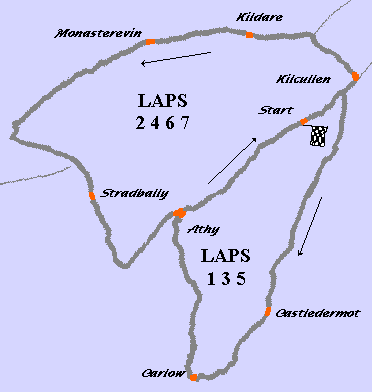
The racing track consisted of two parts forming an "8". The shorter 40-mile loop was to be raced three times and the 52 mile loop four times. On seven points where the track passed towns there were check points and non-racing zones where the cars instead ran at a certain speed behind a bicycle. A system was developed so that cars would leave the zones with certain intervals preventing the need for passing on the track! The roads were bettered with steam rollers and before the race the surface was prepared with a mix of petroleum and ammonia to hinder dust.
Four countries participated in the 1903 event in the following configuration:
Great Britain:
- 1. Edge, Napier, Vertical, 4, 166 x 152 mm = 13726 cc, shaft, 80bhp
- 5. Jarrott, Napier, Vertical, 4, 140 x 127 mm = 7709 cc, shaft, 45bhp
- 9. Stocks, Napier, Vertical, 4, 140 x 127 mm = 7709 cc, shaft, 45bhp
France:
- 2. De Knyff, Panhard, Vertical, 4, 160 x 170 mm = 13672 cc, chain, 80bhp
- 6. Gabriel, Mors, Vertical, 4, 145 x 175 mm = 11559 cc, chain, 70bhp
- 10. Farman, Panhard, Vertical, 4, 160 x 170 mm = 13692 cc, chain, 80bhp
USA:
- 3. Owen, Winton, Horizontal, 4, 133 x 152 mm = 8513 cc, shaft, 40bhp
- 7. Mooers, Peerless, Vertical, 4, 152 x 152 mm = 11082 cc, shaft, 80bhp
- 11. Winton, Winton, Horizontal, 8, 131 x 152 mm = 17016 cc, shaft, 80bhp
Germany:
- 4. Jenatzy, Mercédès, Vertical, 4, 140 x 150 mm = 9230 cc, chain, 65bhp
- 8. De Caters, Mercédès, Vertical, 4, 140 x 150 mm = 9230 cc, chain, 65bhp
- 12. Keene, Mercédès, Vertical, 4, 140 x 150 mm = 9230 cc, chain, 65bhp
Only Britain and the United States had tried to arrange some kind of more or less farcical qualifying events to find their competitors. It was clear from the beginning that Mercédès should represent Germany and the French again did the selection on old merits.
There were lots of troubles with the performance of new Mercédès cars before they finally all were destroyed in a factory fire. Mercédès had to send three standard cars instead, supplied by their Paris agent, Monsieur Charley (alias Karl Lehmann). There were also other kinds of trouble as Jellinec of Mercédès and the German automobile club couldn't agree on the drivers, the former wanting professionals for his cars and the latter only accepting "gentlemen". At the end no German drivers were selected and two Belgians and one American driver were sent to the race to represent Germany. The best known of them was Jenatzy.
With a spectacular driving style and featuring a big red beard Camille Jenatzy was known as the "Le Diable Rouge" (the red devil). He was a Belgian engineer born in 1868, who had turned to motor racing with his own constructions. He became famous for his duels with Comte de Chasseloup-Laubat over the total speed record. With his electrical driven "Jamais Contente" (Never satisfied) on 29 April 1899 Jenatzy became the first to race a car in a speed of over 100 km/h. In the 1900 Gordon Bennett race he tried his luck with a car of his own design. Then from 1903 onwards he raced for Mercédès until 1910. He predicted that one day he would die in a Mercédès.
At 7:00 on July 2nd 1903 everything was ready for the 1903 Gordon Bennett race and Edge's green Napier took off from Kilrush to the cheers of the spectators. He was followed seven minutes later by De Knyff on his dark blue Panhard, then Owen on his Winton, Jenatzy on his white Mercédès and the others one by one. Foxhall-Keene stalled his Mercédès but that did not prevent him from being fastest on the first lap followed by Edge. The first retirement of the day was Stocks after a collision with a wire barricade at Ballymoore, the driver and mechanic surviving with only minor injures after having been thrown out. All the Americans were in great trouble from the beginning, Mooers' first lap taking over 2 hours.
Lap 1
- Keene, D, 46.03
- Edge, GB, + 0.20
- Farman, F, + 1.28
- Jarrott, GB, + 2.11
Gabriel's streamlined Mors made the fastest lap of the day for the longer circuit on lap 2, but at the end of the lap it was Jenatzy who was in the overall lead with De Knyff in second position. Jarrott was the second British retirement when his steering failed in 60 mph on the straight. Fortunately again the riders survived without any serious wounds. Mooers was also out with overheating, reducing the field to nine cars.
Lap 2
- Jenatzy, D, 1:50.17
- De Knyff, F, + 2.01
- Edge, GB, + 3.09
- Gabriel, F, + 3.12
Edge was now falling back with tyre and cooling troubles that would hunt him for the rest of the race. The tyres refused to stay on their rims and not even desperate solutions like throwing barrels of cold water on them would help.
Lap 3
- Jenatzy, D, 2:40.02
- De Knyff, F, + 3.13
- Farman, F, + 7.31
- De Caters, D, + 12.08
Foxhall-Keene had to retire after having damaged the rear axle in a skid. The rear axle proved to be the Achilles heel of the Mercédès cars that day.
Lap 4
- Jenatzy, D, 3:41.54
- De Knyff, F, + 9.37
- Farman, F, + 11.34
- De Caters, D, + 17.35
Winton retired his car, which had proved to be quite fast on the straights but troublesome.
Lap 5
- Jenatzy, D, 4:35.10
- De Knyff, F, + 8.01
- Farman, F, + 9.49
- De Caters, D, + 15.40
When the leader was on his sixth lap it started to rain and it went on to do so for over two hours. However, no accidents occurred, the drivers possibly even preferring the wet conditions for the terrible dust. Farman passed De Knyff (on time, not on the track) for second position. After having set a quite good time on the last lap Owen was now also out, ending the American Gordon Bennett effort for that year.
Lap 6
- 1 Jenatzy, D, 5:36.42
- 2 Farman, F, + 9.34
- 3 De Knyff, F, + 10.08
- 4 De Caters, D, + 21.24
De Knyff was able to re-pass Farman to finish second behind Jenatzy, who took the flag after a steady drive, earning £8000 and taking the Gordon Bennett cup to Germany. The rear axle of de Caters' Mercédès gave up only 10 miles from the finish giving the French the three positions behind the winner. If the luck had been against them in 1902 the French had this time been beaten squarely and fairly.
Finish
- Jenatzy, D, 6:39.00
- De Knyff, F, + 11.40
- Farman, F, + 12.44
- Gabriel, F, + 32.33
Everyone agreed that both the race and the organization had been a extraordinary great success. The infamous Paris-Madrid race a few months earlier had more or less put an end to town-to-town racing and there were no permanent autodromes yet, so for the next two years the Gordon Bennett race would be the main event of the racing calendar.
Jenatzy's end came in 1913, not in a race but during a hunting party on his estate in the Ardennes. One night Jenatzy, a big practical joker, slipped out from the house and hidden in the bushes, he started to imitate the noise of a wild boar. Then suddenly one of his friends leaned out of the window with a rifle and shot him. Jenatzy died in the ambulance on the way to the hospital, and according to legend, the ambulance happened to be a Mercédès, as predicted.
1905
Lively supported by the German Emperor, Kaiser Wilhelm II, the 1904 Gordon Bennett race was held in Homburg near Saarbrücken. The Germans had tried their best to organize a spectacular event of high standard but at a critical moment the communications failed. Jenatzy on his Mercedes had reached the finish line setting the best time but no one knew what was happening behind him on the track. Léon Théry, the winner of the French eliminating trials on a Richard-Brasier, had so far done an outstanding job. Known as "Mort aux Vaches" (the cow killer) after an accident in the Ardennes 1903 Théry had made the first three laps in 1:26:56.8, 1:26.45.8 and 1.29:56.6, leading the race from Jenatzy after three laps. After Jenatzy had taken the flag Théry had some 20 minutes to reach the finish to win the race. They were nervous minutes for the French fans but Théry did not fail them. With some eleven minutes to spare the Richard-Brasier driver appeared at the finish to take the Gordon Bennett Trophy back to "where it belonged". His last lap was the fastest of the day with a time of 1:26:22.2 but it was only 36.6 seconds faster than his second slowest lap. With such constant driving Théry wasn't the cow killer any longer. He now became known as the "Chronometer".
The winning car had been constructed by Brasier for Georges Richard, a well-known voiturette manufacturer. Much smaller than some of the monsters that appeared in racing events at that time the Richard-Brasier was meant to be an "ordinary car" that could be used by ordinary drivers on the roads and not only for racing. Featuring a 4-cylinder engine of 9896 cc it was the only car of the 1904 race with an engine volume less that 10 litres.
It was no secret that the French car manufacturers, dominating the world market, were not at all satisfied with the Gordon Bennett rules, limiting the entries to three cars per nation. In the few years since 1900, when the first Gordon Bennett race was held, motor racing had turned from an amateur event to a fully professional sport with the manufacturers fighting for the good commercial value a victory would bring. As it was, the French eliminating trials were much more competitive than the Gordon Bennett races themselves.
Still it came as a shock when the French announced that the 1905 race would be run in conjunction with another race, a "Grand Prix" with a prize of 100,000 Francs. The entry restrictions for the Grand Prix would be as follows: France 18 cars, Germany and England 6 cars each while the other nations were limited to 3 cars a piece.
The announcement was followed by a storm of protests and finally after a meeting held in Berlin an international commission was set up to solve the troubles. In the end the parties came to the agreement that the Gordon Bennett race and the Grand Prix would be held on different days. Because of the organizing problems such a double event would have created the 1905 Grand Prix was never held but the French announced that whatever the results of the 1905 Gordon Bennett event would be they wouldn't support any 1906 "Coupe Internationale". That announcement meant the end of the Gordon Bennett races and the birth of Grand Prix racing.
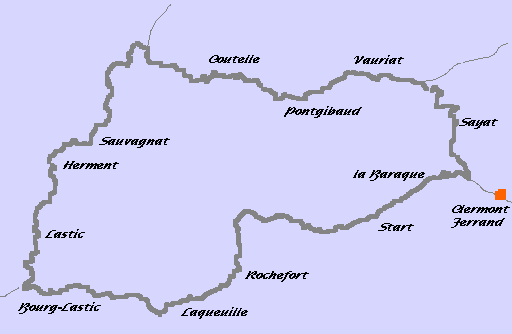
While the Germans had selected the location of the race course for its accessibility and good infrastructure, the French chose to ignore those things and instead tried to find the most demanding terrain available. They found what they looked for in the ancient volcanic hills of Puy-de-Dome, west of Clermont Ferrand. The Auvergne course as it would be called was 137km long and was going up and down the terrain turning and twisting in some 3000 corners, the tightest of them even demanding the drivers to use the reverse gear. Passing was about as easy as in Monaco nowadays.
While the English drivers held their elimination trials on Isle of Man the French held their trials on the actual Auvergne course on 16 June with 24 drivers taking part. Several manufacturers tried to build cars specially suited for the twisty circuit. At the end Théry was again the winner of the trials. His Brasier (Richard had left the firm) was a rebuilt variant of last year's winner with a larger engine, now giving 16bhp more, set further back in the frame.
The line up for the 1905 Gordon Bennett race looked like as follows:
France:
- 1. Théry, Brasier, Vertical, 4, 160 x 140 mm = 11259cc, chain, 96bhp
- 7. Caillois, Brasier, Vertical, 4, 160 x 140 mm = 11259cc, chain, 96bhp
- 13. Duray, De Dietrich, Vertical, 4, 190 x 150 mm = 17012cc, chain, 130bhp
England:
- 2. Earp, Napier, Vertical, 6, 159 x 123 mm = 15083cc, shaft, 90bhp
- 8. Rolls, Wolseley, Horizontal, 4, 152 x 165 mm = 11896cc, shaft, 90bhp
- 14. Bianchi, Wolseley, Horizontal, 4, 152 x 165 mm = 11896cc, shaft, 90bhp
Germany:
- 3. Jenatzy, Mercédès, Vertical, 4, 175 x 146 mm = 14040cc, chain, 115bhp
- 9. de Caters, Mercédès, Vertical, 4, 175 x 146 mm = 14040cc, chain, 115bhp
- 15. Werner, Mercédès, Vertical, 4, 175 x 146 mm = 14040cc, chain, 115bhp
Italy:
- 4. Lancia, FIAT, Vertical, 4, 180 x 160 mm = 16320cc, chain, 100bhp
- 10. Cagno, FIAT, Vertical, 4, 180 x 160 mm = 16320cc, chain, 100bhp
- 16. Nazzaro, FIAT, Vertical, 4, 180 x 160 mm = 16320cc, chain, 100bhp
Austria:
- 5. Braun, Mercédès, Vertical, 4, 175 x 146 mm = 14040cc, chain, 115bhp
- 11. Hieronymus, Mercédès, Vertical, 4, 175 x 146 mm = 14040cc, chain, 115bhp
- 17. Burton, Mercédès, Vertical, 4, 175 x 146 mm = 14040cc, chain, 115bhp
USA:
- 6. Lytle, Pope-Toledo, Vertical, 4, 140 x 140 mm = 8564cc, chain, 60bhp
- 12. Dingley, Pope-Toledo, Vertical, 4, 140 x 140 mm = 8564cc, chain, 60bhp
- 18. Tracy, Locomobile, Vertical, 4, 178 x 178 mm = 17657cc, chain, 90bhp
The Swiss entries never materialized.
5 July at 6 a.m. with 80,000 spectators gathered to see the event Théry took off on his Brasier to start the Gordon Bennett motor race. He was followed five minutes later by Earp, then Jenatzy and all the others in intervals, Tracy taking off as the last at 7:25. The cars were timed on the first kilometre, the German Mercédès cars being the fastest followed by Lancia's FIAT.
As expected Théry was the first one to re-appear at the end of the first lap but less than nine minutes later came a great shock to the spectators as Lancia, who had passed both Earp and Jenatzy, made a time 6 minutes faster than the French favourite. The FIATs were really flying with three Italians among the top four. All the cars except for Dingley's Pope-Toledo made it through the first lap but the other Americans were struggling and the Mercédès entries were also in trouble with the inflexible suspension creating tyre problems, Jenatzy being down in 13th position after a series of punctures and falling behind the Italians and the French entries.
LAP 1
- Lancia, I, 1:34.57
- Théry, F, + 6.10
- Cagno, I, + 10.47
- Nazzaro, I, + 11.16
On the second lap Lancia continued to dominate, opening up the gap with another 6 minutes, even if his lap time was slower due to tyre troubles. Duray on the De Dietrich had managed to pass Cagno and Nazzaro for third. Hieronymus was the first Mercédès driver to call it a day.
LAP 2
- Lancia, I, 3:17.08
- Théry, F, + 12.56
- Duray, F, + 15.32
- Cagno, I, + 19.15
On the third lap Lancia retired with overheating after his radiator was pierced by a stone. The driver buried his face in his hand, weeping over his misfortune. Théry was now finally up in the lead from the two remaining FIATs with Caillois fourth after Duray had had a broken water pipe. Tracy was out of the race, as was Jenatzy with a broken front spring and Burton as the Austrians now were out of tyres!
LAP 3
- Théry, F, 5:18.46
- Nazzaro, I, + 9.45
- Cagno, I, + 11.26
- Caillois, F, + 21.03
Now no-one could do anything about "the Chronometer", who once again did a perfect job to take his second Gordon Bennett victory in a row. The day was saved for the French supporters, after the speed of the Italians had given them all a nasty shock. As soon as Théry stopped the spectators rushed forward and lifted him on their shoulders carrying him around in triumph. Nazzaro and Cagno finished second and third, Caillois fourth, Werner fifth and Duray sixth.
FINISH
- Théry, F, 7:02.43
- Nazzaro, I, + 16.26
- Cagno, I, + 19.40
- Caillois, F, + 24.23
Reader's Why on the 1902 Gordon Bennett race by John Cross
Alexander Winton started a small bicycle business in Cleveland, Ohio, but the coming of the automobile had an irresistible appeal to him and by 1895 he had made his first petrol-powered motor-bicycle. Then in September 1896 he produced his first car which was a vertical twin with friction transmission. In 1897 he formed the Winton Motor Carriage Company and produced his second car. A year later production reached 21 which obviously went to Winton's head because he engaged in a war of words with Fernand Charron about the relative merits of American and French cars and ended up challenging Charron to a 1,000 mile race. Charron put up 20,000 francs but the duel never took place.
At this point, James Gordon Bennett enters the story. He was the Paris-based proprietor of the New York Herald who was best known for sending Henry Stanley to find David Livingstone in Africa, but had also contributed a substantial sum towards the prize money for the 1895 Paris-Bordeaux race (as had a certain William K. Vanderbilt - but that is another story!). Anyway, Bennett was anxious to encourage foreign countries (especially his native United States) to put up a fight against the limitless number of successes attained by French car manufacturers in the road races that were taking place. When he heard about Winton's challenge, he thought that if some valuable trophy were put up for competition, foreign manufacturers would be attracted and might possibly bring the long string of French victories to an end.
So in November 1899 he wrote to the foreign automobile clubs saying he wanted to encourage the automobile industry and was creating an international prize to be competed for by the various automobile clubs of the world. He put the matter in the hands of the Sporting Committee of the Automobile Club de France who drew up a set of 28 rules (the first ever 'formula') which he approved. The club wanted the prize to be named after its donor, but Bennett said he preferred it to be called the 'International Trophy' or 'La Coupe Internationale'. This wish was never obeyed and the races are always remembered as the Gordon Bennett Cup (or Trophy).
The first race was run in 1900 from Paris to Lyons and turned into a bit of a farce, with only 5 cars turning up, including Charron and Winton, of course. Winton's car had a single-cylinder engine of huge but unknown dimensions and tiller steering. Not surprisingly, he was totally outclassed by the French cars, buckled a front wheel before reaching Châteaudun and retired after reaching Orleans. Charron was the winner despite hitting a St Bernard dog at 60 mph and flying off the road! Only one other car completed the course.
As a result, the next two races were run at the same time as other events, including the 1902 race that is featured here. It was run concurrently with the Paris-Vienna race with the Gordon Bennett 'sub-race' running as far as Innsbruck. And it finally saw the French defeated! Yet our heroes so very nearly didn't even start the event...
The 1902 Napier was built round the capabilities of the then very frail and experimental British tyres, and so speed had to be sacrificed to lightness (unlike the huge 1901 Napier which was the first to wear British Racing Green). Certain delays took place in getting this new production on to the road, and it was not until June 19 that it left Napier's dingy little workshop in Lambeth for its initial trials and tuning-up. The race was due to start on June 26 from Paris, from which it will be seen that Edge and Napier only had from the 19th to the 26th in which to discover all its faults, rectify them, get the car over to France and turn up at the starting-point. The heartbreaking obstacles and unforeseen difficulties encountered make the story of that endeavour an epic in the annals of motor racing.
As time was so short, it was necessary for Edge, Napier, Cecil Edge and a gang of mechanics to work the whole of one night in Napier's workshop in order that they might arrive at Folkestone in time to catch the boat. They left Lambeth before it was light; Edge drove, Napier sat in the one passenger seat and Cecil Edge sat on the floorboards. The back of the car was loaded up with heaps of spare tubes, covers, spare parts, personal kit and tools.
The crew had a splendid run to Folkestone, and the general liveliness of the car was in striking contrast to the huge monstrosity of the previous year. It was not until they had practically reached Folkestone that their trouble began, and the very first of them appeared to be their Waterloo. Edge felt a sudden change in the behaviour of the engine; he pulled into the roadside, opened the bonnet and discovered that one of the cylinder heads had cracked and water was pouring into the cylinders.
Immediately, Napier gave up all hope. No spare cylinder head existed, so he said, and it was futile to attempt to do anything. He was so certain that nothing could be done that he left Edge and his cousin by the roadside, walked to the nearest hotel, booked a room and went to bed. The situation looked very black, but it occurred to Edge that Napier might be mistaken about there being no spare cylinder head in existence. Encouraged by this thought, he made for the nearest telephone in the hope of getting in contact with Bitter, Napier's foreman at the Napier factory. A long-distance call in 1902 was vastly different to what it is today. It demanded good luck to obtain a number and better luck still to hear anything over so long a distance. In both respects, Edge was fortunate, and his feelings can be imagined when Bitter informed him that there was a spare cylinder head in existence and that two of his best men should be sent by the first available train to Folkestone to fit it, and that if necessary, they would continue during the crossing so that the car would be ready on arrival in France.
Edge woke up Napier and informed him of the good news, and the three of them set about having the car towed to the landing stage, where they could prepare the engine for the new cylinder head. Afterwards, they went to the station to meet the two mechanics, and the engine was prepared in mid-Channel; by the time they reached Boulogne, the car was quite ready to be driven off the boat. They decided to send one of the mechanics back and to take the other one to Paris in case of further trouble.
All appeared to be well, but the hand of Nemesis was soon to descend on them with renewed strength.
On a slight incline near Abbeville, the engine started to race, and a noise came from the gearbox that nearly froze their hearts. They slid back the cover, and found that the teeth of the second-speed pinion were nearly bent over; by some fearful oversight at the factory, the second-speed shaft had been fitted without the teeth having been case-hardened!
Unfortunately, the car had only three speeds, and to attempt to compete with only first and top speeds was out of the question. First of all, they made certain that no teeth had been broken off and were lying in the grease, and having done so, they proceeded on their way, using first and top gears only. Napier said that if it were possible to find some workshop, he thought he would be able to case-harden the teeth himself after straightening them up again. Edge knew Clement quite well, and so it was arranged that on arrival in Paris they would hire a stable where they could dismantle the gearbox. Edge would then go in search of Clement and explain that their car needed some adjustment. Great care would have to be taken to avoid disqualification from the race, for it was stipulated that every part of the car must be made in the country of its origin. If an extensive repair were undertaken, it might be held that this rule had been transgressed.
Edge found Clement, who gladly gave permission to use his factory; the gearbox was taken down, the faulty shaft conveyed to the factory and there Napier and his mechanic proceeded to straighten the teeth and case-harden them, while Edge and his cousin took what little rest was possible. It was a race against time, and time was nearly victorious, for after working the whole of that night in re-erecting the gearbox, only a few minutes were left in which to drive the car to the Ministry of Mines for examination and weighing-in.
Then another trouble occurred. When Edge went to back the car out of the stable, he found that the reversing gear would only stop in mesh for a second, and as soon as the clutch was let in, it flew out of mesh. There was no time to do anything, and so the car was driven to the Ministry of Mines at once and with a reverse that was practically useless, although Edge well knew that he had to demonstrate to the Ministry that the car had an effective reversing gear.
As he was driving down the Champs Elysees, he happened to see Claude Johnson, the secretary of the then A.C.G.B.I. who had gone to see the race on behalf of the Club. He pulled up and offered him a lift; they had not gone far before a French policeman jumped out and held up his hand for them to stop. Edge sensed that he would demand to see his French driving licence, and that if he had committed some paltry offence the licence would be confiscated and that would be an end to everything. Before they pulled up, Edge told Johnson - who spoke French as well as he spoke English - not to open his mouth but to leave everything to him.
The policeman asked to see the driving licence. Edge pretended not to understand a word he was saying. The policeman made signs that he wished to see something so Edge produced various things he had in his pocket, including his pocket book, his season-ticket to Birmingham, various odd letters and so forth, but still the policeman was not satisfied. Finally, Edge pulled out his watch and showed it to him. The watch happened to have Edge's name engraved on the back, and as soon as the policeman saw the name his face lit up with a smile of recognition. The licence forgotten, he explained that they had both been fellow-competitors in the Bordeaux-Paris cycle race of 1891, and shook Edge warmly by the hand before waving him on.
Letting in the clutch, Edge proceeded as quickly as possible to the Ministry of Mines for the examination. Bluff had overcome the difficulty with the policeman, so perhaps bluff would get him out of the forthcoming difficulty over the reverse gear.
An inspector came up to examine the car, and at last the awful moment came for Edge to demonstrate that it was fitted with an effective reversing gear. The reversing pinion would only stay in for a moment, and if he had to drive back for any distance, he would be completely finished. The Inspector signed for Edge to drive backwards. The reversing pinion was engaged, and then Edge raced up the engine as if he were about to drive backwards at a hundred miles per hour. The clutch was let in, and the car moved backwards a few inches before the pinion flew out of mesh. The Inspector said he was satisfied and handed Edge the necessary clearance documents.
Just as he was about to drive off he saw Napier running towards him with a face as long as his arm. Panting for breath, Napier explained that in their haste they had omitted to fit into the gearbox a small distance piece which alone prevented two gears engaging simultaneously; as the gearbox was at the moment, there was nothing to prevent two gears engaging at the same time, in which event no power on earth could stop the whole of the transmission flying into a million pieces. This meant the whole of the gearbox coming down for the second time!
For two consecutive nights none of them had had any sleep. By a series of seeming miracles, they had overcome one difficulty after another, and now, almost at the last moment, the whole of the previous night's work would have to be done over again. Expecting the transmission to go to pieces at any moment, they drove slowly back to the stable and there took off their coats and proceeded to take down the gearbox for the second time. They were too exhausted, disappointed, hungry and begrimed to discuss matters, and hardly a word was exchanged between them while the work was being done.
They had ordered a cold chicken to be prepared at a nearby hotel, and this they intended to carry with them during the race and to eat as they drove along, but time was getting very short when the final nut was screwed up, and they barely had time to fetch the chicken and proceed to the starting-point before the start of the race at 3 a.m.
But their troubles were still not over. When they started up the engine, it began to misfire badly. They could hardly get along, but managed to limp to the starting-point and there they stopped the engine. Edge and his cousin were too utterly exhausted to try to find the cause of the misfiring, so they waited in the car until their turn came.
Then another miracle happened; when started up, the engine fired away perfectly without any trace of a misfire. To the day of his death, Edge was unable to explain the cause of the misfiring or what rectified the trouble; neither he nor his cousin did anything; in some mysterious manner it cured itself.
As though trying to make up for all the trouble of the past day or two, the car flew onwards perfectly; for fully two hundred miles they kept up a good speed with no trouble whatever. They had taken fresh heart and were beginning to think all their troubles were at an end when, without warning, one of the back tyres went flat. They jacked up the back part, fitted a new inner tube, and began to pump up the tyre. Their spirits sank again for the hundredth time. The pump refused to work. They took it to pieces; oiled it, added grease, adjusted the leather washer, but nothing helped; the pump was useless. They were wondering what was the best thing to do in these distressing circumstances when they heard a racing car approaching. Edge stood in the middle of the road and waved his arms. The driver proved to be Count Zborowski - a prince of good sportsmen. Edge explained what had happened, and Zborowski at once threw out his own pump and refused to wait while the tyre was being pumped up!
No further trouble was experienced that day. They arrived at Belfort and the car was locked up for the night. All the hotels were full so they were obliged to rest in an attic over a provision merchant's shop in a side street. In case, in their exhausted state, they should oversleep - the race was due to start again at 3 a.m. on the following day - they gave a policeman a tip to throw small stones through their window to wake them up. This proved effective, but on going to the place where all the competing cars had been locked up for the night, they found all four tyres quite flat. This meant changing four tubes in their ordinary running time.
The second stage to Bregenz was a neutral zone, and competitors were expected to 'tour' this section. The roads had not been prepared in any way and were thick with dust, which added greatly to the discomfort of the journey.
Edge had made arrangements for a man to be sent to Bregenz with a supply of new tyres, but on inquiry, he found that the tyres had been consigned through to Innsbruck and the authorities refused to release them. They were lying on the platform but could not be touched. This was a situation in which Edge always excelled. He told his man to engage the stationmaster or whoever was holding up the tyres in heated conversation, and while doing so to move as far away from the tyres as possible. The man poured forth a torrent of English on the stationmaster who, not understanding a word of what was being said, replied in French. The argument became hotter and hotter, and the hotter it became, the further away the two went from the tyres.
Just when a first-class 'rough-and-tumble' appeared imminent, Edge and his cousin saw their opportunity, quietly took the tyres and retired from the station as quickly as they could.
For the second day they had had no trouble, but the brakes on the car were becoming worse and worse. They had the dreaded Arlberg Pass to cross, and how they were going to make the descent was more than Edge could say. The brakes consisted merely of metal bands lined with leather, all of which had burnt away, and no amount of adjustment had any effect.
On arriving at the enclosure where all the competing cars had been stored for the night, they once again found all four tyres flat; once more, the four tubes were changed, and they had the satisfaction of hearing their engine burst into song immediately.
By this time Edge had heard that Girardot, the holder of the Gordon Bennett Trophy, had dropped out, and this meant that only De Knyff was still in the running. If De Knyff broke down and Edge could reach Innsbruck, he would have won the race.
The car was still going well and they pushed on as fast as possible until the Arlberg Pass loomed up ahead. Edge described the descent of the Pass with all brakes entirely out of operation as a hair-raising experience. The descent was a never-ceasing series of twists and corners, and the thought that an instant's inattention would mean death for both of them was unpleasant, to put it mildly. Numerous cars were passed hors de combat, while some of the drivers had lost their nerve with the continual strain of keeping clear of that awful drop.
As the brakes were quite useless, Edge had to adopt the old method of 'double-clutching', coming through to a lower gear and then letting in the clutch against the slow-running engine. Some hundreds of times this was done, but their difficulties were increased enormously by the fact that every fifty yards or so the road had been flattened out in order that the horses might have a rest on level ground. This meant that the descent somewhat resembled going down a flight of steps, with a violent series of crashing jolts every time they struck one of these flat portions and left it for the next decline at speed.
When they arrived at the foot of the Pass, they pulled up to see whether the car was still intact after the fearful buffeting it had had. Their horror can be imagined when they discovered that the whole of the back part of the body had vanished, and with it had gone all their spare parts, tools, jack and inner tubes. They did not possess so much as a bicycle spanner. The spare covers were still there, but of what use were they now they had lost their jack and spare inner tubes?
They had passed a Panhard car on the descent which had apparently broken down, but they did not know whose car it was. While they were wondering what was the best thing to do in their own circumstances, Jarrott came along and informed them that the broken-down Panhard was De Knyff's, and that they only had to reach Innsbruck to win the race!
This news put fresh life into them both. What they had to decide was whether, by some means they did not know, they would remove the worn covers and replace them with the spare ones and so protect the only inner tubes they had, or whether they would risk the existing covers holding out until Innsbruck. They decided to play for safety and somehow or other, replace the worn covers by new ones.
Edge said that of all the many wrestling matches he had with cars during his forty-odd years of motoring, nothing ever compared with this struggle at the foot of the Arlberg Pass to remove, with bare hands and without a jack, the two covers and replace them, and in the knowledge that the trophy was positively within grasp if they succeeded. They proceeded to Innsbruck and after much trouble, in which the French did all in their power to disqualify them, they were awarded the famous Gordon Bennett International Trophy, a victory that was of immense value to the British motor industry.
The heavy-car class of the main Paris-Vienna race was won by Henri Farman on a 70-h.p. Panhard averaging 38.4mph, but contrary to all expectations, the real winner went to the light-car class, where Marcel Renault, whose car only weighed 646kg, covered the distance in 15 hours, 47 minutes, 43 seconds, against Farman' s time of 16 hours, 30 seconds.
Renault's arrival at the finishing point was dramatic. It was on the trotting track at the Prater near Vienna. At about 2 p.m. a car dashed up on to the track, but Renault took the wrong course - the shorter one - and so was obliged to go back to the entrance and make another circuit. Fifteen minutes were lost, but Renault was safe as Count Zborowski on his Mercédès did not arrive for some time.
It is an arguable point whether the heavy-car section should not have been awarded to Zborowski instead of to Farman, as the former had been penalized for about half an hour by some non-observance of customs formalities, and to this day it is held in some quarters that Farman should not have been declared the winner of his particular class.
Although only one Panhard car had trouble with a broken frame owing to the weight restriction having been observed too severely in the design of this component, there is no doubt that had more attention been given to strength and less to mere speed and power, the Gordon Bennett Trophy would have remained in France. The bad roads over the Arlberg Pass took severe toll of the heavy cars that had been subjected too greatly to weight reductions. In the Panhards, one transverse front spring was used and the sub-frame, on which the engine was usually mounted, was abolished and the engine attached to the main frame. The Panhard that Jarrott drove finished with the frame sagging so much in the middle that the driver could not take out the clutch; he had to patch the frame up with wood to enable him to finish.
The Paris-Vienna-cum-Gordon Bennett races of 1902 registered a turn in racing-car design. It became clear to designers that instead of designing larger and larger engines, more power should be squeezed from smaller ones without sacrificing strength and reliability. Scientific weight reduction was what was needed, not increasing cylinder-bores and the like. It would be a waste of money mounting a huge engine into a frame too light or too hole-riddled to bear the severe stresses.
It was the Paris-Vienna race of 1902 that opened the eyes of designers to the wrong road they were taking.
Reader's Why on the 1903 Gordon Bennett race by Hans Etzrodt
The Belgian Camille Jenatzy, nicknamed 'The Red Devil' was born in Brussels on November 4, 1868. His family was of Hungarian origin and had been in Brussels since 1750. He grew up with the velocipede followed by bicycle where he won races while he gained a civil engineering degree. Later, when he did not drive racing cars, he was occupied in the family business, the Jenatzy - Pneumatic, the first rubber factory in Belgium, founded by his father. In 1897 he went to Paris to take part in the great motorcar movement. He was one of the great pioneers of the auto sport and devoted his time to the manufacture of electrical carriages at his General Transport Company.
Camille Jenatzy was first seen in November 28, 1898, when he entered his own electric car at the 1.8 km Chanteloup hill climb and won his first ever racing event. Thereafter he participated in several speed contests, which culminated in 1899 when he had designed and built an electric bullet-shaped streamlined record car, named La Jamais Contente - 'The Never Satisfied'. With this car he set the world speed record on April 29 at 105.882 km/h, a record, which stood for three years. Around that time, he also bought a 16 hp Mors and entered at the 1899 Tour de France, where he smashed a front wheel outside Vichy, which set him back and he came ninth. The following week at the Paris to St. Malo race he placed seventh. His last race that year was the Paris-Ostend event where he came fifth.
Jenatzy participated in the first Gordon Bennett race in 1900 but had to retire. He then disappeared from the racing scene to prepare his own petrol-driven car in Brussels, which was built at FN (Fabrique Nationale d'Armes de Guerre). During 1901, he appeared in only one event, the big Paris-Berlin race, where he retired again, driving one of the Mercedes factory cars. His self-designed 60-hp Jenatzy Heavy-Car was ready in July 1902 for the Ardennes circuit race. The car lost a wheel at full speed and crashed into a pine forest. It was completely destroyed, with the motor and one part of the frame on one side of the road, and the back axle and wheels some hundred meters down the road on the other side. That anyone could have survived such a horrendous crash seemed incredible but Jenatzy had escaped without serious injury. When passing the scene, Charles Jarrott saw his bloodstained face and bandaged head as Jenatzy waved his hand to him while proceeding in a small car to the next control. This whole episode started the legend that this Jenatzy was the devil in person also because he had red hair with a red pointed beard; he was christened the 'Red Devil'. Jenatzy was not seen at other races during 1902, he stopped building his own car and spent time in the family tire factory.
Mercedes offered him one of the works cars for the Paris-Madrid race in 1903, where he placed eleventh. Then followed the fourth Gordon Bennett Cup almost six weeks later, which he won driving again for Mercedes in his reckless, daring style. Jarrott said about Jenatzy, that he was a meek and mild individual when off his car. After his great hard fought victory, everybody now knew Jenatzy's name. For the 1904 Gordon Bennett Cup he tried to repeat his victory, practicing morning after morning for weeks before the race, two laps per day, until he knew every little corner. But Théry was too good and Jenatzy came second a few minutes behind in one of the hardest fought races ever run. At the 1906 Vanderbilt Cup Race Jenatzy placed fifth. Still with Mercedes, his best placing during the 1907 races was third at the Ardennes Circuit Race. New management at Mercedes dropped Jenatzy from the team for the 1908 Grand Prix and he drove a Mors instead, but placed only sixteenth. In 1909 he participated with a Mercedes at the Ostende week, where he won the heavy car class. Driving a "180 hp Mercedes" in 1910, the red-bearded Belgian won the Antwerp Kilometer speed contest and at the week from Ostende, he reached a speed of 172 km/h. He established a new record at the Boulogne-sur-Mer mountain climb and came second at Gaillon.
Camille Jenatzy spent most of his time managing his new tire factory outside Brussels where he also manufactured removable rims. His career ended in a tragic accident on October 7, 1913, on a wild boar hunt in the Ardennes with his friend Madoux, director of the Brussels daily l'Etoile Belge. But according to AUTOMOBIL-REVUE, number 50 of December 13, 1913, this hunting party took place on December 8. At nightfall Jenatzy walked out of his hiding place. In the dusky light his friend saw a shape appearing in about 50 meters distance and took it for a stag. Madoux fired. There was a scream, and when Madoux rushed over he found his hunting friend Jenatzy on the ground, bleeding profusely and wheezing severely. The projectile, an explosion-bullet, had hit the hip, burst apart and ripped his complete left side open. Help was impossible. Camille Jenatzy died within a few minutes.
Jenatzy's biggest success remained the fourth Gordon Bennett Cup in 1903, which was the first of those events to be staged outside France. It went to England after S.F. Edge on a Napier had won the Paris-Innsbruck race in 1902. Because the law prohibited motor races on public roads in England, it took a special act by Parliament, after a large enough area was eventually decided on in Ireland. Two combined circuits were found around Athy, forming a figure eight, to be covered three times for one and four times for the other circuit, a total of seven laps or 527 km. Now, for the first time, a race had to be held especially for the Gordon-Bennett Cup, with teams of not more than three cars from each national automobile club, the cars built entirely in the country they represented and were not to exceed the 1,000 kg weight limit. Britain would be defending the Gordon Bennett Cup against France and for the first time Germany and again the United States. Therefore, this was considered as the first truly international automobile race where cars had to be painted again in different colors to identify the competing Nations: The Americans were red, the English cars were green, the French blue and the Germans white.
The entry consisted of 12 cars, three each from America, England, France and Germany. The Automobile Club of America selected Winton's 8-cylinder, 17-liter, 80 hp special, Owen's 4-cylinder, 40 hp Winton and Mooers on a 80 hp Peerless. Six English cars and drivers wanted to take part in the race and therefore eliminating trials were held beforehand to determine the third car, the first two places went to the holder of the trophy, the Napier firm. Edge was chosen as the defender with a new 13-liter Napier and Jarrott on a 7.8-liter Napier. The other four cars went to the eliminating trial at Walbeck and the outcome was that J. W. Stocks on another 7.8-liter, 45 hp Napier was given the third place in the English team. The cars chosen for France were Gabriel's Morse, winner of the shortened Paris-Madrid event along with 13.7-liter Panhards for De Knyff and Henry Farman. The three 11.9-liter 90 hp Mercedes to be entered were destroyed in a fire at the Cannstatt plant during the night of June 10, just three weeks before the Gordon Bennett Cup. The Daimler Motoren Gesellschaft and Emil Jellinek called back last years 9.2-liter, 60hp touring cars from their owners, fitting racing trim at the factory. Jenatzy drove Dinsmore's car, which had been already back in Europe, and De Caters drove a car recalled by the Paris dealership. Foxhall Keene, who drove Mercedes in Europe since 1901, offered the third car but only if he was to drive it and was accepted. The German Automobil Klub declined the two German drivers Werner and Braun and the only other 60 hp Mercedes available in Germany at that time was that of Willy Pöge.
The start was at seven in the morning and Edge was the first car off with the other cars being dispatched in seven minutes intervals. At the end of the first of the seven laps, Foxhall Keene's Mercedes was leading Edge by seven seconds. The Winton encountered serious carburetion problems and had started 40 minutes late. On the first lap J. W. Stocks left the road and was out with a smashed front wheel. After the completion of two laps, covering 92 miles, the spectacular driving Jenatzy led De Knyff by two minutes. Edge had fallen to third place due to tire failures and Jarrott crashed seriously after the steering gear broke, escaping with serious bruises and a broken collarbone. Jenatzy kept pulling away further from the closely bunched three French cars. After three laps, the rear axle on Foxhall Keene's Mercedes broke. Baron DeCaters in the other Mercedes suffered an identical breakage only 16 kilometers from the finish but the Red Devil in the last Mercedes went even faster, chased by the three blue cars from France. Charles Jarrott, who drove the 7.8-liter Napier reported that he had an opportunity to see how Jenatzy was driving on a very winding road where the Belgian redbeard went "all out". In his book Jarrott wrote,"Some of his skids on the corners were hair-raising, and he missed several stone walls only by a fraction, judging by his wheel marks. I did not think it possible that he could continue to take such risks and survive. De Knyff evidently thought the same. But his brilliance was not to be denied and he came through in magnificent style." After six hours and 39 minutes, Camille Jenatzy won with his Mercedes, by almost 12 minutes, averaging 79 km/h, which assured the race to be held in Germany the following year. In second place followed De Knyff, with Farman and Gabriel third and fourth respectively. Edge struggled in last place. The American cars had failed, both Winton and Peerless.
Emil Bremme, the German Bugatti driver during the twenties, later owned Jenatzy's winning 60 hp Mercedes from 1903. By that time the car had a touring body and his owner drove it for fun.
Reader's Why on the 1905 Gordon Bennett race by Richard Armstrong
Théry is shown on his way to his second successive victory in the final Gordon Bennett Trophy, retaining the title he had won at Homburg in Germany the previous year. Once again he fully justified the soubriquet "The Chronometer" which had been first applied at Homburg in deference to his remarkably even-paced race. Now he had surely forever laid the ghost of his previous nickname earned at the expense of an unfortunate cow which strayed into his path during the 1902 Circuit des Ardennes: Mort aux Vaches.
Théry's car is often erroneously referred to as a Richard-Brasier: in fact Georges Richard had severed his connection with the firm shortly before the race although contemporary and later reports continued to use the name. So dominant had the Richard-Brasiers been in 1904, that Brasier was confident enough to merely uprate the existing design for 1905 - according to some reports, the same chassis were rebuilt with new engines of an increased capacity: 11,259cc as against 9,896cc and a consequent increase in horsepower from 80bhp to 96bhp.
Two Brasiers, driven by Théry and Caillois, successfully negotiated the French eliminating trials and along with Duray's De Dietrich, they formed the French team which lined up against no less than six Mercedes (three each from Germany and Austria). There were also teams from Italy (three FIATs), Great Britain (two Wolseleys and a Napier) and the USA (two Pope-Toledos and an enormous 17.6 litre Locomobile).
In the race itself Théry was flagged away first and duly reappeared just over an hour and forty-one minutes later, still at the head of the field. The French crowd's satisfaction with this soon turned to consternation however, when the second car to appear was the FIAT of Vincenzo Lancia, which had started in fourth place - he had passed both Earp's Napier and Jenatzy's Mercedes and recorded a lap time six and a half minutes faster than Théry. Even worse from the French point of view was the revelation that the other two FIATs were running third and fourth although the second lap provided some relief: Lancia extended his lead by another six and a half minutes, beating Théry at his own game but for France Duray was also the model of consistency and eased past Cagno and Nazzaro in the other FIATs. Then on the third lap disaster struck the Italian team when Lancia's engine seized after a stone holed the radiator - he broke down in tears when he realised that his race was run. Duray, too, was in trouble with a broken water pipe and lost an hour on the leader in just one lap, but once repairs had been made he was able to run at a competitive pace once more and his fourth and final lap was second only to Théry's. The two FIATs finished second and third, with Nazzaro leading Cagno home by just over two minutes. Caillois finished fourth in the second Brasier and after nearly seven and a half hours of racing, the top four were separated by less than five minutes: a measure of the superiority of the leaders was that Werner's fifth-placed Mercedes was over thirty minutes behind Caillois.